Advertisements
Advertisements
प्रश्न
In ∆ABC, AB = `6sqrt(3)` cm, AC = 12 cm, and BC = 6 cm then m∠A = ?
विकल्प
30°
60°
90°
45°
Advertisements
उत्तर
30°
Explanation:
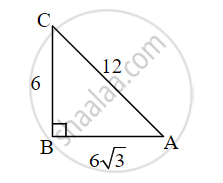
We know that, `6 = 1/2(12)`
And `6sqrt(3) = sqrt(3)/2 (12)`
∴ `BC = 1/2 AC` and `AB = sqrt(3)/2 AC`
∴ ∠A = 30° ...(Converse of 30° - 60° - 90° theorem)
APPEARS IN
संबंधित प्रश्न
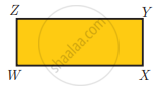
In the rectangle WXYZ, XY + YZ = 17 cm, and XZ + YW = 26 cm. Calculate the length and breadth of the rectangle?
The hypotenuse of a right triangle is 6 m more than twice of the shortest side. If the third side is 2 m less than the hypotenuse, find the sides of the triangle
5 m long ladder is placed leaning towards a vertical wall such that it reaches the wall at a point 4 m high. If the foot of the ladder is moved 1.6 m towards the wall, then find the distance by which the top of the ladder would slide upwards on the wall.
If in ∆ABC, DE || BC. AB = 3.6 cm, AC = 2.4 cm and AD = 2.1 cm then the length of AE is
In a ∆ABC, AD is the bisector of ∠BAC. If AB = 8 cm, BD = 6 cm and DC = 3 cm. The length of the side AC is
The incentre is equidistant from all the vertices of a triangle
Check whether given sides are the sides of right-angled triangles, using Pythagoras theorem
12, 13, 15
Check whether given sides are the sides of right-angled triangles, using Pythagoras theorem
9, 40, 41
Check whether given sides are the sides of right-angled triangles, using Pythagoras theorem
24, 45, 51
The area of a rectangle of length 21 cm and diagonal 29 cm is __________
In right angled triangle, if sum of the squares of the sides of right angle is 169, then what is the length of the hypotenuse?
If the length of diagonal of square is `sqrt(2)`, then what is the length of each side?
If length of both diagonals of rhombus are 60 and 80, then what is the length of side?
If a triangle having sides 50 cm, 14 cm and 48 cm, then state whether given triangle is right angled triangle or not
In ∆LMN, l = 5, m = 13, n = 12 then complete the activity to show that whether the given triangle is right angled triangle or not.
*(l, m, n are opposite sides of ∠L, ∠M, ∠N respectively)
Activity: In ∆LMN, l = 5, m = 13, n = `square`
∴ l2 = `square`, m2 = 169, n2 = 144.
∴ l2 + n2 = 25 + 144 = `square`
∴ `square` + l2 = m2
∴ By Converse of Pythagoras theorem, ∆LMN is right angled triangle.
In ΔABC, AB = 9 cm, BC = 40 cm, AC = 41 cm. State whether ΔABC is a right-angled triangle or not. Write reason.
