Advertisements
Advertisements
प्रश्न
If the length of diagonal of square is `sqrt(2)`, then what is the length of each side?
विकल्प
2
`sqrt(3)`
1
4
Advertisements
उत्तर
1
Explanation:
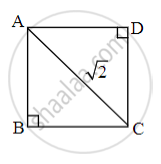
Let ABCD be the given square.
In ∆ABC,
∠B = 90°
∴ AC2 = AB2 + BC2 ...[Pythagoras theorem]
∴ `(sqrt(2))^2 = AB^2 + AB^2` ...[Sides of the square]
∴ 2 = 2AB2
∴ AB2 = 1
∴ AB = 1 unit
APPEARS IN
संबंधित प्रश्न
In ∆PQR, PQ = √8 , QR = √5 , PR = √3. Is ∆PQR a right-angled triangle? If yes, which angle is of 90°?
Sides of the triangle are 7 cm, 24 cm, and 25 cm. Determine whether the triangle is a right-angled triangle or not.
If in ∆ABC, DE || BC. AB = 3.6 cm, AC = 2.4 cm and AD = 2.1 cm then the length of AE is
In a ∆ABC, AD is the bisector of ∠BAC. If AB = 8 cm, BD = 6 cm and DC = 3 cm. The length of the side AC is
Two poles of heights 6 m and 11 m stand vertically on a plane ground. If the distance between their feet is 12 m, what is the distance between their tops?
If the sides of a triangle are in the ratio 5 : 12 : 13 then, it is ________
The incentre is equidistant from all the vertices of a triangle
Check whether given sides are the sides of right-angled triangles, using Pythagoras theorem
8, 15, 17
Check whether given sides are the sides of right-angled triangles, using Pythagoras theorem
12, 13, 15
Check whether given sides are the sides of right-angled triangles, using Pythagoras theorem
24, 45, 51
In right angled triangle, if sum of the squares of the sides of right angle is 169, then what is the length of the hypotenuse?
In ∆ABC, AB = `6sqrt(3)` cm, AC = 12 cm, and BC = 6 cm then m∠A = ?
If a triangle having sides 8 cm, 15 cm and 17 cm, then state whether given triangle is right angled triangle or not
In ΔABC, AB = 9 cm, BC = 40 cm, AC = 41 cm. State whether ΔABC is a right-angled triangle or not. Write reason.
In the given figure, triangle PQR is right-angled at Q. S is the mid-point of side QR. Prove that QR2 = 4(PS2 – PQ2).

In a right angled triangle, right-angled at B, lengths of sides AB and AC are 5 cm and 13 cm, respectively. What will be the length of side BC?
