Advertisements
Advertisements
प्रश्न
If the amplitude of a wave is doubled, what will be the effect on its loudness?
Advertisements
उत्तर
The loudness of sound is directly proportional to the square of the amplitude of waves.
Loudness ∝ (amplitude)2 When the amplitude is doubled loudness becomes (2)2 = 4 times
संबंधित प्रश्न
If the amplitude of vibration is large, sound is feeble.
The sound from a mosquito is produced when it vibrates its wings at an average rate of 500 vibrations per second. What is the time period of the vibration?
In which units is the loudness of sound measured?
The pitch of a stringed instrument is increased by .................. tension in string.
The pitch of a flute is decreased by ................... length of air column.
Smaller the membrane, .................. is the pitch.
The safe limit of loudness of audible sound is
How does sound travel in air?
How is loudness related to the amplitude of wave?
Why is the loudness of sound heard by a plucked wire increased when mounted on a sound board?
Name and define the characteristic which enables one to distinguish two sounds of same loudness, but of different frequencies, given by the same instrument.
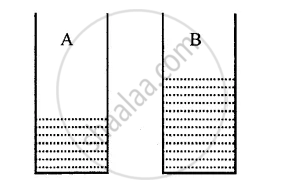
Figure shows two jars A and B containing water up to different heights. Which will produce sound of higher pitch when air is blown on them?
Two identical guitars are played by two persons to give notes of the same loudness and pitch. Will they differ in quality? Give reason for your answer.
Two musical notes of the same pitch and same loudness are played on two different instruments. Their wave patterns are as shown in figure.
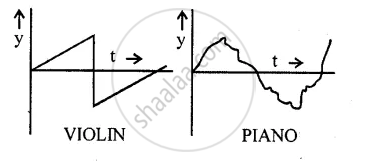
How do they differ in
(a) loudness,
(b) pitch and
(c) quality
- Which of the following quality determines the loudness of a sound wave?
- wavelength
- frequency and
- amplitude
- How is loudness related to the quantity mentioned above in part (a)?
What is meant by the ‘loudness’ of a sound? How is it related to the intensity?
The frequency of the stretched string of a fixed length is f when it is plucked in the middle. Where should it be plucked so that string vibrates with frequency (i) 2f, (ii) 3f?
Draw diagrams to show these vibrations and name them.
If ______ of sound is decreased, its loudness also decreases.
What is acoustics?
