Advertisements
Advertisements
प्रश्न
If `sec θ = 13/5`, show that `(2 sin θ - 3 cos θ)/(4 sin θ - 9 cos θ) = 3`.
Advertisements
उत्तर १
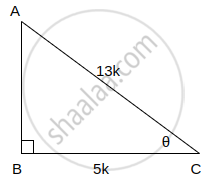
Given: `sec θ = 13/5`
We know that,
sec θ = `"Hypotenuse"/"Adjacent Side"`
sec θ = `13/5 = "AC"/"BC"`
Let AC = 13k and BC = 5k
In ΔABC, ∠B = 90°
By Pythagoras theorem,
AC2 = AB2 + BC2
(13k)2 = AB2 + (5k)2
AB2 = 169k2 – 25k2
AB2 = 144k2
AB = 12k
sin θ = `"AB"/"AC" = "12k"/"13k" = 12/13`
cos θ = `"BC"/"AC" = "5k"/"13k" = 5/13`
LHS = `(2 sin θ - 3 cos θ)/(4 sin θ - 9 cos θ)`
LHS = `[2 × (12/13) - 3 × (5/13)]/[4 × (12/13) - 9 × (5/13)]`
LHS = `[24/13 - 15/13]/[48/13 + 45/13]`
LHS = `[9/13]/[3/13]`
LHS = `9/(cancel13) × cancel13/3`
LHS = `9/3`
LHS = 3
RHS = 3
LHS = RHS
`(2 sin θ - 3 cos θ)/(4 sin θ - 9 cos θ) = 3`
Hence proved.
उत्तर २
Given: sec θ = `13/5`
cos θ = `1/secθ = 5/13`
sin2θ = 1 – cos2θ
sin2θ = `1 - (5/13)^2`
sin2θ = `1 - 25/169`
sin2θ = `(169 − 25)/169`
sin2θ = `144/169`
sin θ = `12/13`
Now, put the values in the equation,
LHS = `(2 sin θ - 3 cos θ)/(4 sin θ - 9 cos θ)`
LHS = `(2 × (12/13) - 3 × (5/13))/(4 × (12/13) - 9 × (5/13))`
LHS = `(24/13 - 15/13)/(48/13 - 45/13)`
LHS = `((24- 15)/cancel13)/((48 - 45)/cancel13)`
LHS = `9/3`
LHS = 3
RHS = 3
LHS = RHS
`(2 sin θ - 3 cos θ)/(4 sin θ - 9 cos θ) = 3`
Hence proved.
संबंधित प्रश्न
In ΔABC right angled at B, AB = 24 cm, BC = 7 m. Determine:
sin C, cos C
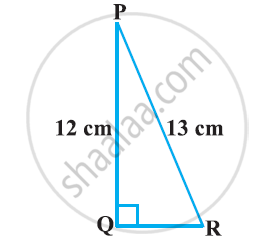
In Given Figure, find tan P – cot R.
If sin A = `3/4`, calculate cos A and tan A.
Given sec θ = `13/12`, calculate all other trigonometric ratios.
If cot θ = `7/8`, evaluate cot2 θ.
State whether the following are true or false. Justify your answer.
cot A is the product of cot and A.
In the following, trigonometric ratios are given. Find the values of the other trigonometric ratios.
`cosec theta = sqrt10`
If `cot theta = 1/sqrt3` show that `(1 - cos^2 theta)/(2 - sin^2 theta) = 3/5`
if `tan theta = 12/13` Find `(2 sin theta cos theta)/(cos^2 theta - sin^2 theta)`
Evaluate the Following
4(sin4 60° + cos4 30°) − 3(tan2 60° − tan2 45°) + 5 cos2 45°
Evaluate the following:
(cosec2 45° sec2 30°)(sin2 30° + 4 cot2 45° − sec2 60°)
Evaluate the Following
`4/(cot^2 30^@) + 1/(sin^2 60^@) - cos^2 45^@`
Evaluate the Following
4(sin4 30° + cos2 60°) − 3(cos2 45° − sin2 90°) − sin2 60°
Evaluate the Following:
`tan 45^@/(cosec 30^@) + sec 60^@/cot 45^@ - (5 sin 90^@)/(2 cos 0^@)`
In ΔABC is a right triangle such that ∠C = 90° ∠A = 45°, BC = 7 units find ∠B, AB and AC
If cosec θ - cot θ = `1/3`, the value of (cosec θ + cot θ) is ______.
The value of cos 0°. cos 1°. cos 2°. cos 3°… cos 89° cos 90° is ______.
If sin A = `1/2`, then the value of cot A is ______.
If 4 tanθ = 3, then `((4 sintheta - costheta)/(4sintheta + costheta))` is equal to ______.
Find the value of sin 45° + cos 45° + tan 45°.
What will be the value of sin 45° + `1/sqrt(2)`?
`sqrt(3)` cos2A + `sqrt(3)` sin2A is equal to ______.
If sin θ + cos θ = `sqrt(2)` then tan θ + cot θ = ______.
Let tan9° = `(1 - sqrt((sqrt(5)k)/m))k` where k = `sqrt(5) + 1` then m is equal to ______.
If b = `(3 + cot π/8 + cot (11π)/24 - cot (5π)/24)`, then the value of `|bsqrt(2)|` is ______.
If `θ∈[(5π)/2, 3π]` and 2cosθ + sinθ = 1, then the value of 7cosθ + 6sinθ is ______.
