Advertisements
Advertisements
प्रश्न
If cot θ = `7/8` evaluate `((1+sin θ )(1-sin θ))/((1+cos θ)(1-cos θ))`.
If cot θ = `7/8` then find the value of `((1+sin θ )(1-sin θ))/((1+cos θ)(1-cos θ))`.
Advertisements
उत्तर १
Let us consider a right triangle ABC, right-angled at point B.
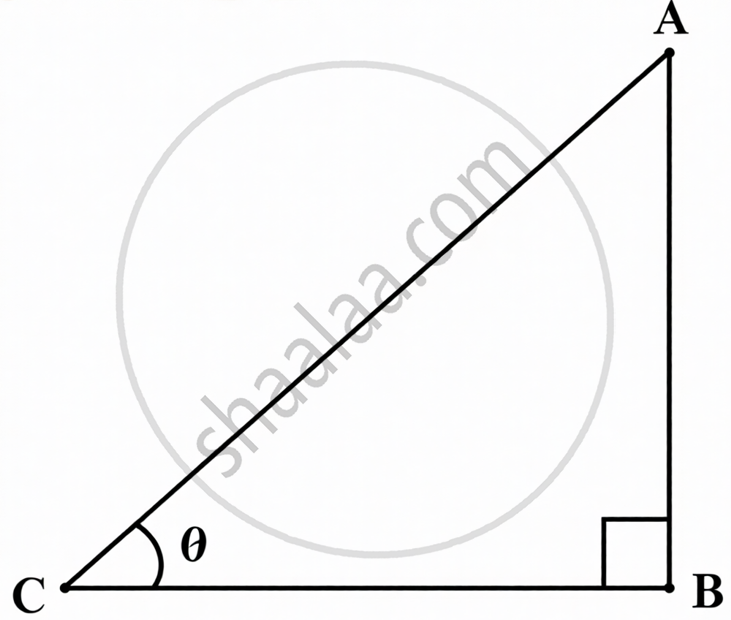
`cot theta = 7/8`
If BC = 7k, then AB = 8k, where k is a positive integer.
Applying Pythagoras theorem in ΔABC, we get
AC2 = AB2 + BC2
= (8k)2 + (7k)2
= 64k2 + 49k2
= 113k2
AC = `sqrt113k`
`sin theta = (8k)/sqrt(113k) = 8/sqrt(113)`
`cos theta = (7k)/sqrt(113k) = 7/sqrt113`
`((1+sin θ )(1-sin θ))/((1+cos θ)(1-cos θ)) = (1-sin^2θ)/(1-cos^2θ)`
= `(1-(8/sqrt113)^2)/(1-(7/sqrt(113))^2)`
= `(1-64/113) /(1-49/113)`
= `((113 - 64)/113) /((113 - 49)/113)`
= `(49/113)/(64/113)`
= `49/64`
उत्तर २
`cot theta = 7/8`
`((1 + sin θ)(1 - sin θ))/((1 + cos θ)(1 - cos θ))`
= `(1 - sin^2 theta)/(1 - cos^2 theta)` ...[∵ (a + b) (a – b) = a2 − b2] a = 1, b = sin θ
We know that sin2θ + cos2θ = 1
1 − sin2θ = cos2θ
1 − cos2θ = sin2θ
= `(cos^2 theta)/(sin^2 theta)`
= `cot^2 theta`
= `(cot theta)^2`
= `[7/8]^2`
= `49/64`
APPEARS IN
संबंधित प्रश्न
In ΔABC right angled at B, AB = 24 cm, BC = 7 m. Determine:
sin C, cos C
If ∠A and ∠B are acute angles such that cos A = cos B, then show that ∠A = ∠B.
In the following, trigonometric ratios are given. Find the values of the other trigonometric ratios.
`sin theta = 11/5`
In the following, one of the six trigonometric ratios is given. Find the values of the other trigonometric ratios.
`tan alpha = 5/12`
If `sin θ = 3/4` prove that `sqrt(("cosec"^2θ - cot^2θ)/(sec^2θ - 1)) = sqrt(7)/3`.
Evaluate the following:
`sin^2 30° cos^2 45 ° + 4 tan^2 30° + 1/2 sin^2 90° - 2 cos^2 90° + 1/24 cos^2 0°`
Evaluate the following:
`cot^2 30^@ - 2 cos^2 60^circ- 3/4 sec^2 45^@ - 4 sec^2 30^@`
If sin (A − B) = sin A cos B − cos A sin B and cos (A − B) = cos A cos B + sin A sin B, find the values of sin 15° and cos 15°.
The value of sin² 30° – cos² 30° is ______.
If cosec θ - cot θ = `1/3`, the value of (cosec θ + cot θ) is ______.
`(1 + tan^2 "A")/(1 + cot^2 "A")` is equal to ______.
If A and (2A – 45°) are acute angles such that sin A = cos (2A – 45°), then tan A is equal to ______.
Given that sinα = `1/2` and cosβ = `1/2`, then the value of (α + β) is ______.
The value of the expression `[(sin^2 22^circ + sin^2 68^circ)/(cos^2 22^circ + cos^2 68^circ) + sin^2 63^circ + cos 63^circ sin 27^circ]` is ______.
Prove the following:
If tan A = `3/4`, then sinA cosA = `12/25`
Find the value of sin 0° + cos 0° + tan 0° + sec 0°.
If sin θ + cos θ = `sqrt(2)` then tan θ + cot θ = ______.
If cos(α + β) = `(3/5)`, sin(α – β) = `5/13` and 0 < α, β < `π/4`, then tan (2α) is equal to ______.
The maximum value of the expression 5cosα + 12sinα – 8 is equal to ______.
If sinθ = `1/sqrt(2)` and `π/2 < θ < π`. Then the value of `(sinθ + cosθ)/tanθ` is ______.
