If α and β are the zeroes of the quadratic polynomial f(x) = ax^2 + bx + c, then evaluate 1/(aalpha + b) + 1/(abeta + b).
Advertisements
प्रश्न
If α and β are the zeroes of the quadratic polynomial f(x) = ax2 + bx + c, then evaluate `1/(aalpha + b) + 1/(abeta + b)`.
Advertisements
उत्तर
Since α and β are the zeros of the quadratic polynomial f(x) = ax2 + bx + c
α + β = `-"Coefficient of x"/"Coefficient of x"^2`
= `(-b)/a`
ab = `"Constant term"/"Coefficient of x"^2`
= `c/a`
We have, `1/(aalpha + b) + 1/(abeta + b)`
`1/(aalpha + b) + 1/(abeta + b) = (abeta + b + aalpha + b)/((aalpha + b)(abeta + b))`
`1/(aalpha + b) + 1/(abeta + b) = (a(alpha + beta) + 2b)/(a^2 xx alphabeta + ab beta + ab alpha + b^2)`
`1/(aalpha + b) + 1/(abeta + b) = (a(alpha + beta) + 2b)/(a^2 alpha beta + ab(alpha + beta)+ b^2)`
By substituting `a + beta = (-b)/a and alphabeta = c/a "we get",`
`1/(aalpha + b) + 1/(abeta + b) = (a xx(-b)/a + 2b)/(a^2 xx c/a + ab xx (-b)/a + b^2)`
`1/(aalpha + b) + 1/(abeta + b) = (cancela xx (-b)/cancela + 2b)/(a^(cancel2^1)xx c/cancela + cancelab xx (-b)/cancela + b^2)`
`1/(aalpha + b) + 1/(abeta + b) = (-b + 2b)/(a xx c - b^2 + b^2)`
`1/(aalpha + b) + 1/(abeta + b) = b/(ac - cancel(b^2) + cancel(b^2))`
`1/(aalpha + b) + 1/(abeta + b) = b/(ac)`
Hence, the value of `1/(aalpha+b)+1/(abeta+b) "is" b/(ac)`.
APPEARS IN
संबंधित प्रश्न
Find the zeros of the quadratic polynomial 9x2 - 5 and verify the relation between the zeros and its coefficients.
Find the zeroes of the following quadratic polynomial and verify the relationship between the zeroes and the coefficients:
4s2 – 4s + 1
Find the zeroes of the following quadratic polynomial and verify the relationship between the zeroes and the coefficients.
6x2 – 3 – 7x
If α and β are the zeros of the quadratic polynomial f(x) = ax2 + bx + c, then evaluate `1/alpha+1/beta-2alphabeta`
If α and β are the zeros of the quadratic polynomial p(y) = 5y2 – 7y + 1, find the value of `1/α + 1/β`.
If α and β are the zeros of the quadratic polynomial p(s) = 3s2 − 6s + 4, find the value of `alpha/beta+beta/alpha+2[1/alpha+1/beta]+3alphabeta`
If α and β are the zeros of the quadratic polynomial f(x) = x2 – p(x + 1) – c, show that (α + 1)(β + 1) = 1 – c.
If the zeros of the polynomial f(x) = 2x3 – 15x2 + 37x – 30 are in A.P., find them.
Find the quadratic polynomial whose zeroes are `2/3` and `(-1)/4`. Verify the relation between the coefficients and the zeroes of the polynomial.
The product of the zeros of x3 + 4x2 + x − 6 is
If two zeroes of the polynomial x3 + x2 − 9x − 9 are 3 and −3, then its third zero is
If p(x) = axr + bx + c, then –`"b"/"a"` is equal to ______.
If 2 and `1/2` are the zeros of px2 + 5x + r, then ______.
Case Study -1
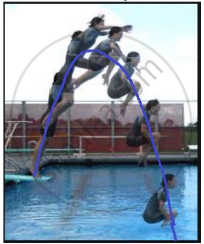
The figure given alongside shows the path of a diver, when she takes a jump from the diving board. Clearly it is a parabola.
Annie was standing on a diving board, 48 feet above the water level. She took a dive into the pool. Her height (in feet) above the water level at any time ‘t’ in seconds is given by the polynomial h(t) such that h(t) = -16t2 + 8t + k.
The zeroes of the polynomial r(t) = -12t2 + (k - 3)t + 48 are negative of each other. Then k is ______.
If one of the zeroes of the quadratic polynomial (k – 1)x2 + k x + 1 is –3, then the value of k is ______.
For the following, find a quadratic polynomial whose sum and product respectively of the zeroes are as given. Also, find the zeroes of these polynomials by factorization.
`21/8, 5/16`
Find the zeroes of the quadratic polynomial 6x2 – 3 – 7x and verify the relationship between the zeroes and the coefficients.
Find the sum and product of the roots of the quadratic equation 2x2 – 9x + 4 = 0.
If α, β are zeroes of quadratic polynomial 5x2 + 5x + 1, find the value of α2 + β2.
A quadratic equation whose roots are \[ \alpha, \beta \] can be written as:
