Advertisements
Advertisements
प्रश्न
If `a/b = c/d = e/f`, prove that `(ab + cd + ef)^2 = (a^2 + c^2 + e^2) (b^2 + d^2 + f^2)`.
Advertisements
उत्तर
Let `a/b = c/d = e/f = k` then
a = bk, c = dk and e = fk
L.H.S.
= (ab + cd + ef)2
= (bk·b + dk·d + fk·f)2
= k2 (b2 + d2 + f2)2
R.H.S.
= (a2 + c2 + e2)(b2 + d2 + f2)
= (b2k2 + d2k2 + f2k2)(b2 + d2 + f2)
= k2 (b2 + d2 + f2)(b2 + d2 + f2)
= k2 (b2 + d2 + f2)2.
L.H.S. = R.H.S.
Hence proved.
संबंधित प्रश्न
If a, b, c and dare in continued proportion, then prove that
`sqrt (("a + b + c")("b + c + d")) = sqrt "ab" + sqrt "bc" + sqrt "cd"`
If a, b, c are in continued proportion, prove that a : c = (a2 + b2) : (b2 + c2).
If a, b, c, d are in continued proportion, prove that:
`sqrt(ab) - sqrt(bc) + sqrt(cd) = sqrt((a - b + c) (b - c + d)`
Show that the following numbers are in continued proportion:
48, 60, 75
If the cost of a dozen soaps is Rs 285.60, what will be the cost of 15 such soaps?
4.5 g of an alloy of copper and zinc contains 3.5 g of copper. What weight of copper will there be in 18.9 g of the alloy?
Which of the following ratios are in proportion?
There is a number in the box `square` such that `square`, 24, 9, 12 are in proportion. The number in the box is ______.
Determine if the following are in proportion.
24, 28, 36, 48
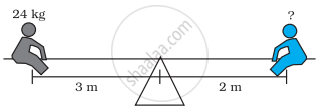
Unequal masses will not balance on a fulcrum if they are at equal distance from it; one side will go up and the other side will go down.
Unequal masses will balance when the following proportion is true:
`("mass"1)/("length"2) = ("mass"2)/("length"1)`

Two children can be balanced on a seesaw when
`("mass"1)/("length"2) = ("mass"2)/("length"1)`. The child on the left and child on the right are balanced. What is the mass of the child on the right?