Advertisements
Advertisements
प्रश्न
If a, b, c are in continued proportion, prove that: a2 b2 c2 (a-4 + b-4 + c-4) = b-2(a4 + b4 + c4)
Advertisements
उत्तर
Given: a, b, c are in continued proportion.
`a/b = b/c` = k
`a/b` = k ∴ a = bk
`b/c` = k ∴ b = ck
L.H.S. = a2 b2 c2 (a-4 + b-4 + c-4)
L.H.S. = `a^2b^2c^2[1/a^4 + 1/b^4 + 1/c^4]`
L.H.S. = `(a^2b^2c^2)/a^4 + (a^2b^2c^2)/b^4 + (a^2b^2c^2)/c^4`
L.H.S. = `(b^2c^2)/a^2 + (c^2a^2)/b^2 + (a^2b^2)/c^2`
L.H.S. = `((ck)^2.c^2)/((ck^2)^2) + (c^2(ck^2)^2)/(ck)^2 + ((ck^2)^2(ck)^2)/(c^2)`
L.H.S. = `(c^2k^2.c^2)/(c^2k^4) + (c^2.c^2k^4)/(c^2k^2) + (c^2k^4.c^2k^2)/(c^2)`
L.H.S. = `c^2/k^2 + (c^2k^2)/(1) + (c^2k^6)/(1)`
L.H.S. = `c^2[1/k^2 + k^2 + k^6]`
L.H.S. = `c^2/k^2[ 1 + k^4 + k^8]`
R.H.S. = b- 2 [a4 + b4 + c4]
R.H.S. = `(1)/b^2[a^4 + b^4 + c^4]`
R.H.S. = `(1)/(ck)^2[(ck^2)^4 + (ck)^4 + c^4]`
R.H.S. = `(1)/(c^2k^2)[c^4k^8 + c^4k^4 + c^4]`
R.H.S. = `c^4/(c^2k^2)[k^8 + k^4 + 1]`
R.H.S. = `c^2/k^2[1 + k^4 + k^8]`
∴ L.H.S. = R.H.S.
Hence proved.
APPEARS IN
संबंधित प्रश्न
Using properties of proportion, solve for x:
`(sqrt(x + 1) + sqrt(x - 1))/(sqrt(x + 1) - sqrt(x - 1)) = (4x - 1)/2`
Find the mean proportion of the following :
24 and 6
If ( a+c) : b = 5 : 1 and (bc + cd) : bd = 5 : 1, then prove that a : b = c : d
If a, 12, 16 and b are in continued proportion find a and b.
Determine if the following numbers are in proportion:
32, 48, 70, 210
If the cost of a dozen soaps is Rs 285.60, what will be the cost of 15 such soaps?
If 12 L of diesel is consumed by a car in covering a distance of 222 km, how many kilometers will it go in 22 L of diesel?
35 inland letters cost Rs 87.50. How many such letters can we buy for 315?
Are the following statements true?
32 m : 64 m = 6 sec : 12 sec
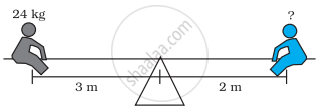
Unequal masses will not balance on a fulcrum if they are at equal distance from it; one side will go up and the other side will go down.
Unequal masses will balance when the following proportion is true:
`("mass"1)/("length"2) = ("mass"2)/("length"1)`

Two children can be balanced on a seesaw when
`("mass"1)/("length"2) = ("mass"2)/("length"1)`. The child on the left and child on the right are balanced. What is the mass of the child on the right?