Advertisements
Advertisements
प्रश्न
If A and B are complementary angles, prove that:
`(sinA + sinB)/(sinA - sinB) + (cosB - cosA)/(cosB + cosA) = 2/(2sin^2A - 1)`
Advertisements
उत्तर
Since, A and B are complementary angles, A + B = 90°
`(sinA + sinB)/(sinA - sinB) + (cosB - cosA)/(cosB + cosA)`
= `(sinA + sinB)/(sinA - sinB) + (cos(90^@ - A) - cos(90^@ - B))/(cos(90^@ - A) + cos(90^@ - B))`
= `(sinA + sinB)/(sinA - sinB) + (sinA - sinB)/(sinA + sinB)`
= `((sinA + sinB)^2 + (sinA - sinB)^2)/((sinA - sinB)(sinA + sinB)`
= `(sin^2A + sin^2B + 2sinAsinB + sin^2A + sin^2B - 2sinA)/(sin^2A - sin^2B`
= `2(sin^2A + sin^2B)/(sin^2A - sin^2B)`
= `2(sin^2A + sin^2(90^@ - A))/(sin^2A - sin^2(90^@ - A))`
= `2(sin^2A + cos^2B)/(sin^2A - cos^2B)`
= `2/(sin^2A - (1 - sin^2A))`
= `2/(2sin^2A - 1)`
APPEARS IN
संबंधित प्रश्न
If `tan theta = 12/5` find the value of `(1 + sin theta)/(1 -sin theta)`
If \[\cos \theta = \frac{2}{3}\] find the value of \[\frac{\sec \theta - 1}{\sec \theta + 1}\]
If 5 tan θ − 4 = 0, then the value of \[\frac{5 \sin \theta - 4 \cos \theta}{5 \sin \theta + 4 \cos \theta}\] is:
If θ and 2θ − 45° are acute angles such that sin θ = cos (2θ − 45°), then tan θ is equal to
Find the sine ratio of θ in standard position whose terminal arm passes through (4,3)
Find the value of the following:
`(cos 70^circ)/(sin 20^circ) + (cos 59^circ)/(sin31^circ) + cos theta/(sin(90^circ - theta))- 8cos^2 60^circ`
Prove that `(tan A)/(cot A) = (sec^2A)/("cosec"^2A)`.
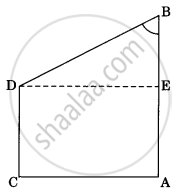
In the given figure, if AB = 14 cm, BD = 10 cm and DC = 8 cm, then the value of tan B is ______.
2(sin6 θ + cos6 θ) – 3(sin4 θ + cos4 θ) is equal to ______.
Sin 2B = 2 sin B is true when B is equal to ______.
