Advertisements
Advertisements
प्रश्न
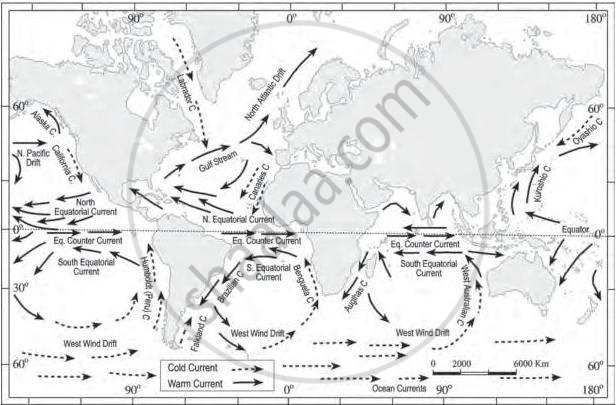
How is the movement of currents influenced by prevailing winds? Give some examples from the following figure.
Advertisements
उत्तर
Prevailing winds are one of the primary driving forces behind the movement of surface ocean currents. The friction of the wind blowing across the ocean surface drags the water along with it, setting the current in motion[cite: 21].
Here are key ways this influence is shown, with examples based on standard diagrams like figure:
-
Influence of Trade Winds: In the tropics, the steady easterly trade winds push surface water from east to west, creating the major Equatorial Currents that flow along the equator[cite: 21].
-
Example from figure: The North Equatorial Current and South Equatorial Current in both the Atlantic and Pacific Oceans are driven westward by the trade winds.
-
-
Influence of Westerlies: In mid-latitudes, the prevailing westerly winds push surface water from west to east, creating the major Drift Currents or Boundary Currents that flow eastward across ocean basins[cite: 21].
-
Example from figure: The powerful North Atlantic Drift (part of the Gulf Stream system) and the North Pacific Current in the northern hemisphere, and the West Wind Drift in the southern hemisphere, are all pushed eastward by the westerlies.
-
-
Deflection by Continents and the Coriolis Force: The movement of water set in motion by these prevailing winds is not always straight. Currents are deflected by the Earth’s rotation (Coriolis Force) to the right in the Northern Hemisphere and to the left in the Southern Hemisphere, and they are steered by continental landmasses, creating large circular gyres[cite: 21].
-
Example from figure: In the North Atlantic, the Gulf Stream (moving north) is deflected by the Coriolis force and the shape of North America to flow east across the Atlantic, completing the subtropical gyre.
-
