Advertisements
Advertisements
प्रश्न
How does sound from a sound producing body travel through air to reach our ears? Illustrate your answer with the help of a labelled diagram.
Advertisements
उत्तर
When an object vibrates, then the air layers around it start to vibrate in exactly the same way and causes successive compression and rarefaction that carry sound waves from the sound-producing object to our ears.
Example: A tuning fork vibrates and produces sound waves in air. Since the prongs of the tuning fork vibrate, the individual layers of air also start to vibrate, creating successive compression and rarefaction. Sound travels in the form of longitudinal waves in which the back and forth vibrations of the air layers are in the same direction as the movement of sound wave.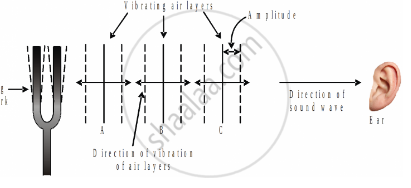
APPEARS IN
संबंधित प्रश्न
Fill in the blank.
Sound is produced when a body ______.
A person is listening to a tone of 500 Hz sitting at a distance of 450 m from the source of the sound. What is the time interval between successive compressions from the source?
Can sound travel through vacuum?
What is the general name of the waves consisting of :
(a) compressions and rarefactions?
(b) crests and troughs?
What will be the change in the wavelength of a sound wave in air if its frequency is doubled?
Name four ways in which sound can be produced.
If a ringing bicycle bell is held tightly by hand, it stops producing sound. Why?
When the pitch of note produced by a harmonium is lowered, then the wavelength of the note :
Write the answer in your own words.
What is meant by vibration?
Sound is produced by ______.
