Advertisements
Advertisements
प्रश्न
How does sound from a sound producing body travel through air to reach our ears? Illustrate your answer with the help of a labelled diagram.
Advertisements
उत्तर
When an object vibrates, then the air layers around it start to vibrate in exactly the same way and causes successive compression and rarefaction that carry sound waves from the sound-producing object to our ears.
Example: A tuning fork vibrates and produces sound waves in air. Since the prongs of the tuning fork vibrate, the individual layers of air also start to vibrate, creating successive compression and rarefaction. Sound travels in the form of longitudinal waves in which the back and forth vibrations of the air layers are in the same direction as the movement of sound wave.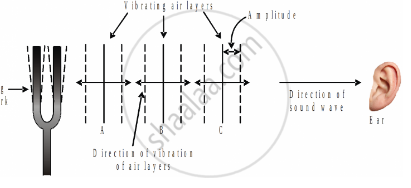
APPEARS IN
संबंधित प्रश्न
Name two sources of sound.
Explain why you can predict the arrival of a train by placing your ear on the rails without seeing it.
What minimum distance is required between the source of sound and the reflecting surface to hear an echo ? Give reason.
Which characteristics of the sound helps you to identify your friend by his voice while sitting with others in a dark room?
Name the device which is used to produce sound in laboratory experiments?
Draw the sketches of two waves A and B such that wave A has twice the wavelength and half the amplitude of wave B.
How is sound produced in a human larynx and a loudspeaker?
Sound is produced by ______.
You and your friend are on the moon. Will you be able to hear any sound produced by your friend?
Infrasound can be heard by
