Advertisements
Advertisements
प्रश्न
How did the presence of Richard Parker help Pi?
Advertisements
उत्तर
Pi had to be alert to stay alive in the presence of a 450-pound heavy tiger whose moods may swing. The tiger’s presence did not allow him to think much about his family and the tragic circumstances he was placed in life. He had to keep alert to stay alive. He hated Richard Parker but was grateful to the animal for keeping him out of despair, an enemy much more formidable than the Bengal tiger.
APPEARS IN
संबंधित प्रश्न
If you are punished for a prank your classmate played, how would you react to the situation?
What were the circumstances that led to Aksionov’s imprisonment?
Why did Aksionov give up sending petitions?
Compare and contrast the main characters, Aksionov and Makar Semyonich, in the story
Why did Pi want to tame Parker?
If you were lost at sea for as long as Pi was, what is the one item you would want with you? Write a diary entry in which you identify the item and explain why it is the one thing you would want with you.
What was Baldwin’s advice to Gresham?
Why was John filled with shame?
How was Baldwin’s honesty rewarded?
Sketch the character of:
i) Robert Baldwin
ii) John Gresham.
Who do you think exhibits true friendship–Baldwin or Gresham? Justify your answer.
Did Max’s presence alarm Ausable?
Where did Max try to hide himself?
Describe the significance of the balcony.
Ausable planned to get rid of Max the very moment he noticed him. Explain with supporting evidence from the story
Do you think physical appearance matters most for a secret agent? Answer giving reasons in the context of the story ‘The Midnight Visitor.
Given below are pictures of fictitious detective characters in English & Tamil short stories. Match them with the authors who created them.
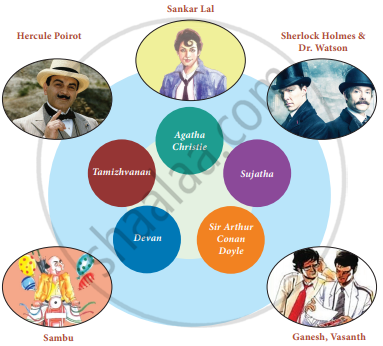
What makes the earth the one and only living planet?
Name a few things that make the earth a unique planet.

What does Margot like the most - the sun or the rain?
Margot could recall what the sun looked like while the other children could not. Why?
What happens to Margot while the teacher is out of the classroom?
How did Margot describe the sun to others?
Now read the sentence below. Complete them appropriately with the word you identified from the grid.
William and other children have bullied her and ______her in a closet.
Now read the sentence below. Complete them appropriately with the word you identified from the grid.
When the Sun comes out, the children ______the Sun.
Now read the sentence below. Complete them appropriately with the word you identified from the grid.
The children are _______ of Margot and ______the door and let her out.
Complete the summary of the play, choosing the appropriate words from the list given below the passage.
Lord Weston was a (1)______ judge in England. Being pompous and vain, he told his secretary Roger that he had attained glory by hard work and (2)______. He expressed his displeasure over Roger’s request for a half-holiday. Suddenly, he discovered a piece of paper with the words (3)______ in his pocket, and he feared that the message was a warning conveyed by his enemies who had received legal punishments from him. As the message was sent on the 15th of March, (the day Julius Caesar was assassinated), he was (4)______ that someone affected by his fair judgement was plotting his murder. Sensing the definite attack, Lord Weston ordered his secretary to (5)______ all the doors and windows. But his wife remained (6)______ by the threat. So, Lord Weston was angered by her (7)______ reaction. He ordered Roger to send the cook and the (8)______ away. Both Weston and Roger took elaborate precautionary measures to thwart the (9)______ attempt. Finally, Weston was able to recollect that he had written the message “Remember Caesar” himself as a (10)______. Caesar was actually a gardener who had an appointment to visit Weston’s garden. The play revolves around Weston’s absent-mindedness which is the crux of the play.
| callous | unperturbed |
| well-known | gardener |
| reminder | zealous service |
| Remember Caesar | assassination |
| shut | convinced |
Who reminded Lord Weston about Mr. Caesar?
Bring out the irony in the message “Remember Caesar”
