Advertisements
Advertisements
प्रश्न
Heterolytic fission of C–C bond results in the formation of ______.
विकल्प
free radical
Carbanion
Carbocation
Carbanion and Carbocation
Advertisements
उत्तर
Heterolytic fission of C–C bond results in the formation of carbanion and carbocation.
APPEARS IN
संबंधित प्रश्न
For the following reactions
- \[\ce{CH3CH2CH2Br + KOH → CH3 – CH = CH2 + KBr + H2O}\]
- \[\ce{(CH3)3CBr + KOH → (CH3)3COH + KBr}\]
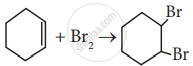
Which of the following statement is correct?
Decreasing order of nucleophilicity is ______.
Homolytic fission of covalent bond leads to the formation of ______.
Which of the group has highest + I effect?
Which of the following species does not exert a resonance effect?
Which of the following carbocation will be most stable?
Assertion: Tertiary Carbocations are generally formed more easily than primary Carbocations ions.
Reason: Hyper conjucation as well as inductive effect due to additional alkyl group stabilize tertiary carbonium ions.
Which of the following represent a set of nucleophiles?
Write a short note on hyperconjucation.
Explain inductive effect with suitable example.
