Advertisements
Advertisements
प्रश्न
a) Give two reasons to explain why reflecting telescopes are preferred over refracting type.
Advertisements
उत्तर
(a) The reflecting telescopes are preferred over refracting type because of the following reasons:
(i) There is no chromatic aberration in case of reflecting telescopes as the objective is a mirror.
(ii) Spherical aberration is reduced in case of reflecting telescopes by using mirror objective in the form of a paraboloid.
APPEARS IN
संबंधित प्रश्न
Define the term 'limit of resolution'?
Use the mirror equation to show a convex mirror always produces a virtual image independent of the location of the object ?
Mark the correct options.
Which of the following (referred to a spherical mirror) do (does) not depend on whether the rays are paraxial or not?
(a) Pole
(b) Focus
(c) Radius of curvature
(d) Principal axis
A light ray falling at an angle of 45° with the surface of a clean slab of ice of thickness 1.00 m is refracted into it at an angle of 30°. Calculate the time taken by the light rays to cross the slab. Speed of light in vacuum = 3 × 10⁸ m s−1.
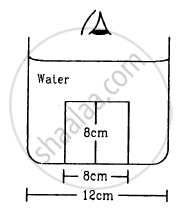
A cylindrical vessel of diameter 12 cm contains 800π cm3 of water. A cylindrical glass piece of diameter 8.0 cm and height 8.0 cm is placed in the vessel. If the bottom of the vessel under the glass piece is seen by the paraxial rays (see figure), locate its image. The index of refraction of glass is 1.50 and that of water is 1.33.
A small object is placed at the centre of the bottom of a cylindrical vessel of radius 3 cm and height 4 cm filled completely with water. Consider the ray leaving the vessel through a corner. Suppose this ray and the ray along the axis of the vessel are used to trace the image. Find the apparent depth of the image and the ratio of real depth to the apparent depth under the assumptions taken. Refractive index of water = 1.33.
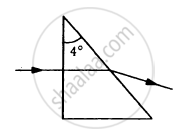
Find the angle of deviation suffered by the light ray shown in figure. The refractive index μ = 1.5 for the prism material.
A light ray, going through a prism with the angle of prism 60°, is found to deviate by 30°. What limit on the refractive index can be put from these data?
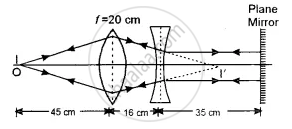
The figure below shows the positions of a point object O, two lenses, a plane mirror and the final image I which coincides with the object. The focal length of the convex lens is 20 cm. Calculate the focal length of the concave lens.