Advertisements
Advertisements
प्रश्न
Give the significance of fertilization.
Advertisements
उत्तर
Significance of fertilization:
- Fertilization maintains the diploid number of chromosomes in the newly formed zygote.
- It combines characters from two parents bringing about variation in the offspring.
- It determines the sex of the offspring.
- Fertilization introduces centrioles in the cell which are missing in the ovum.
APPEARS IN
संबंधित प्रश्न
Suppose a normal woman has never borne a child; How many mature eggs would she have produced in her lifetime? Your calculation should be based on two clues-
(a) Eggs are produced at the rate of 1 egg every 28 days (one menstrual cycle)
(b) A woman’s total reproductive period is 13 – 45 years.
Given below is a portion of the diagram to show the diagrammatic highly magnified view of a single human sperm. Complete the diagram to show its normal structure.

One egg is released from each of the two ovaries every month.
Name the following:
Fusion of sperm and ovum.
The diagram given below is that of a developing human foetus in the womb. Study the same and answer the question that follow:
Name (any one) hormone produced by the part labelled '2'.
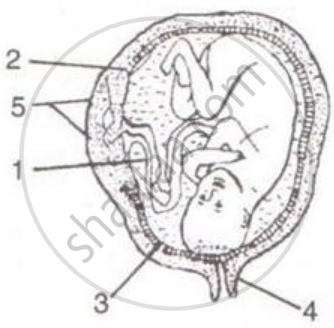
Where does fertilization occur?
Name two essential structures which take part in fertilization.
Give Reasons
A large number of sperms are required for fertilizing one egg.
Study the diagram given below and then answer the questions that follow:
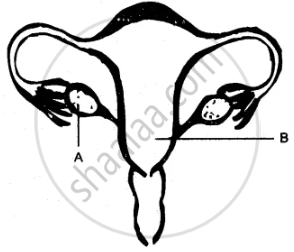
(i) Name the part labeled A. Name any two hormones produced by the part labeled A.
(ii) What happens to the part labeled B.
(1) if fertilization takes place?
(2) If fertilization does not take place?
(iii) Where does fertilization occur?
(iv) Draw a neat diagram of the human sperm as seen under high magnification and label the following parts.
(1) Acrosome
(2) Mitochondria
Complete the following sentences with appropriate word:
One egg is normally released from the ovary in the human females after
__________
Mention, if the following statement is True or False. If false rewrite the wrong statement in its correct form:
Fertilization is the product of the egg nucleus and the sperm nucleus.
Multiple choice question.
In human female, the fertilized egg gets implanted in uterus _______.
What would be the effect if meiosis did not occur in nature?
In markets, eggs of birds are available but never eggs of dogs. why?
State whether the following statement is True or False. If false, correct the statement:
External fertilisation can occur both in water and on land.
What are autosomes chromosomes?
Match the items in column I with those in column II and write down the matching pairs (some may not match).
| Column I | Column II | ||
| (a) | Acrosome | (i) | An embryo which looks like human baby. |
| (b) | Gestation | (ii) | Luteinizing hormone |
| (c) | Menopause | (iii) | Ovum producing cells. |
| (d) | Foetus | (iv) | Semen |
| (e) | Oogenesis | (v) | Spermatozoa |
| (f) | Ovulation | (vi) | Complete stoppage of menstrual cycle. |
| (vii) | Time taken by a fertilised egg till the delivery of baby. |
What are the two sequential blocks that prevent polyspermy?
How are ova classified in terms of yolk content?
