Advertisements
Advertisements
प्रश्न
Give the relationship between the revenue deficit and the fiscal deficit.
Advertisements
उत्तर
The relationship between the revenue deficit and the fiscal deficit can be explained through the following points:
1. Revenue deficit is the difference between government’s revenue expenditures and government’s receipts.
Revenue deficit = Revenue expenditures − Revenue receipts
On the other hand, fiscal deficit is the difference between the total expenditure and the total receipt of the government.
Fiscal deficit = Total Expenditure − Total Receipts (excluding borrowings)
2. The term ‘fiscal deficit’ is used in a broader sense than the term ‘revenue deficit’.
3. As revenue deficit increases, the proportion of fiscal deficit also increases.
APPEARS IN
संबंधित प्रश्न
Fiscal deficit equals :
(a) Interest payments
(b) Borrowings
(c) Interest payments less borrowing
(d) Borrowing less interest payments
Define fiscal deficit.
We suppose that C = 70 + 0.70Y D, I = 90, G = 100, T = 0.10Y (a) Find the equilibrium income. (b) What are tax revenues at equilibrium Income? Does the government have a balanced budget?
Are fiscal deficits inflationary?
Answer the following question.
In the given figure, what does the gap 'KT' represent? State any two fiscal measures to correct the situation.
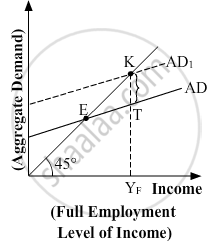
Suppose you are a member of the "Advisory Committee to the Finance Minister of India". The Finance Minister is concerned about the rising Revenue Deficit in the budget.
Suggest anyone measure to control the rising Revenue Deficit of the government.
Read the following statements carefully and choose the correct alternatives given below:
Statement 1: Fiscal Deficit = Total Budget Expenditure - Total Budget Receipts (Net of borrowing)
Statement 2: Primary Deficit = Fiscal Deficit + Interest Payments.
______ are the transactions between the residents of two countries that take place due to consideration of profit.
______ are those transactions that are undertaken to cover deficit or surplus in autonomous transactions.
Which of the following transactions are correct about ORT?
How do we get the primary deficit from the fiscal deficit?
How good is the system of G.S.T as compared to the old tax system?
The three main measures of government deficit are:
If a government's revenue expenditure is ₹700 crore and its revenue receipts are ₹550 crore, the Revenue Deficit is:
The Primary Deficit shows the borrowing requirement of the government:
Which of the following formulas correctly defines the Primary Deficit?
Which of the following formulas correctly defines Revenue Receipts?
The Primary Deficit is always smaller than the Fiscal Deficit because:
