Advertisements
Advertisements
प्रश्न
“Gender of child is determined by the male partner of couple”. Draw a diagram explaining the above statement.
Advertisements
उत्तर
1). The chromosome number in germ cells producing the gametes are diploid i.e. 2n. It includes 22 pairs of autosomes and 1 pair of sex-chromosomes i.e. (44 + XX or 44 + XY).
2). These germ cells divide by meiosis.
3). Due to this, gametes contain only haploid (n) number of chromosomes i.e. (22 + X or 22 + Y).
4). Two types of sperms are produces as (22 + X) or (22 + Y) whereas oocytes are produced of only one type as (22 + X).
5). Both, sperms and oocytes are produced by meiosis.
6). In case of sperms, process of meiotic division is completed before the sperms leave male reproductive tract.
7). However, in case of oocytes, process of meiotic division completes after ovulation; during fertilization in oviduct.
APPEARS IN
संबंधित प्रश्न
State its functions in case of a pregnant human female.
State the changes that take place in the uterus when Female gamete/egg is not fertilised
Write the function of the following part in a human female reproductive system:
Uterus
State the main function of the Sperm duct.
State whether human beings reproduce by sexual method or asexual method.
Which part of the human body passes sperms from a man to a woman?
What is puberty?
What is the role of the seminal vesicles in the human male reproductive system?
Draw a labelled diagram of the human female reproductive system. With the help of this diagram, explain the working of human female reproductive system.
During adolescence, several changes occur in the human body. Mark one change from the following associated with sexual maturation in boys.
When a fertilised egg E formed in the oviduct of a human female divides repeatedly to form an embryo, the embryo gets implanted in the thick and soft lining of the uterus. After this a disc-like special tissue T develops between the uterus wall and embryo through which all the requirements of the developing embryo (and foetus) are met from the mother's body, The embryo is connected to the tissue T through a string like structure S.
(a) What is the other name of fertilised egg cell E?
(b) What is the name of tissue T?
(c) Name the string-like structure S.
(d) Name two substances which pass from mother's blood to embryo through tissue T and, one type of substance which passes from embryo to mother's blood.
(e) What happens to S when the baby is born? Why?
Describe in brief the role of ureter in human male reproductive system.
List two changes observed in girls at the time of puberty.
Describe the role of the following in human beings:
(i) Seminal vesicles
(ii) Prostate gland
Name the following:
Organ where implantation takes place.
Identify the given diagram.
Name the parts 1 to 5. 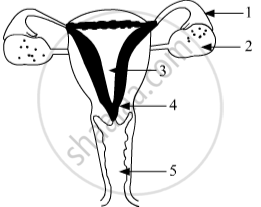
If for some reason, the vasa efferentia in the human reproductive system get blocked, the gametes will NOT be transported form ______
Arrange the following stages of human reproduction in their correct sequential order: Fertilisation, Gametogenesis, Parturition, Insemination, Gestation, Implantation.
Which stage of human reproduction involves the fusion of sperm and egg to form a zygote?
Which of the following is an example of a secondary sexual characteristic in humans?
