Advertisements
Advertisements
प्रश्न
From the following table, determine if x and y are in direct proportion or not.
| x | 4 | 7 | 10 | 16 |
| y | 24 | 42 | 60 | 96 |
Advertisements
उत्तर
In direct proportion, `x/y = k` ...(Constant)
For table
| x | 4 | 7 | 10 | 16 |
| y | 24 | 42 | 60 | 96 |
⇒ `x/y = 4/24, 7/42, 10/60, 16/96`
i.e. `1/6, 1/6, 1/6, 1/6`
So, is in direct proportion.
APPEARS IN
संबंधित प्रश्न
In Question 2 above, if 1 part of a red pigment requires 75 mL of base, how much red pigment should we mix with 1800 mL of base?
If the cost of 93 m of a certain kind of plastic sheet is Rs 1395, then what would it cost to buy 105 m of such plastic sheet?
Working 8 hours a day, Ashu can copy a book in 18 days. How many hours a day should he work so as to finish the work in 12 days?
A cistern has two inlets A and B which can fill it in 12 hours and 15 hours respectively. An outlet can empty the full cistern in 10 hours. If all the three pipes are opened together in the empty cistern, how much time will they take to fill the cistern completely?
In which of the following case, do the quantities vary directly with each other?
Both x and y are in direct proportion, then `1/x` and `1/y` are ______.
When two quantities x and y are in ______ proportion or vary ______ they are written as `x oo y`.
If 25 metres of cloth costs Rs 337.50, then what will be the cost of 40 metres of the same type of cloth?
Here is a keyboard of a harmonium: This pattern of keys is repeated on larger keyboard. How many black keys would you expect to find on a keyboard with 14 such patterns.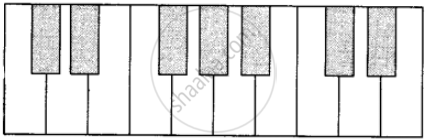
Kusum always forgets how to convert miles to kilometres and back again. However she remembers that her car’s speedometer shows both miles and kilometres. She knows that travelling 50 miles per hour is same as travelling 80 kilometres per hour. To cover a distance of 200 km, how many miles Kusum would have to go?
