Advertisements
Advertisements
प्रश्न
From the following observations taken while determining the resistance of a conductor, draw the current-voltage graph and calculate the resistance of conductor. Is the conductor ohmic?
| Ammeter reading I (in ampere) | Voltmeter reading V (in volt) |
| 0.2 | 0.4 |
| 0.3 | 0.6 |
| 0.5 | 1.0 |
| 0.8 | 1.6 |
| 1.5 | 3.0 |
Advertisements
उत्तर
The current-voltage graph is shown in figure.

Resistance R = `(triangle"V")/(triangle"I")`
`= ((3.0 - 0.6)"V")/((1.5 - 0.3)"A")`
`= (2.4"V")/(1.2"A") = 2 Omega`
The conductor is ohmic.
संबंधित प्रश्न
A battery of emf 12 V and internal resistance 2 Ω is connected with two resistors A and B of resistance 4 Ω and 6 Ω respectively joined in series.
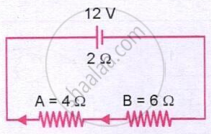
Find:
- Current in the circuit.
- The terminal voltage of the cell.
- The potential difference across 6Ω Resistor.
- Electrical energy spent per minute in the 4Ω resistor.
The p.d. across a lamp is 12 V. How many joules of electrical energy are changed into heat and light when: a current of 2 A flows through it for 10 s?
Keeping the potential difference constant, the resistance of a circuit is halved. By how much does the current change?
Explain the statement ‘the potential difference between two points is 1 volt’.
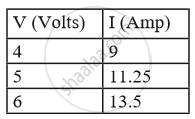
The following table shows current in Amperes and potential difference in Volts.
Which law will the graph prove? Explain the law.
Define the following:
Potential difference
Write an expression for the electrical power spent in flow of current through a conductor in terms of resistance and potential difference.
Three resistors are connected to a 12 V battery as shown in the figure given below:
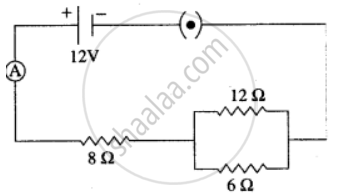
(i) What is the current through the 8 ohm resistor?
(ii) What is the potential difference across the parallel combination of 6 ohm and 12 ohm resistor?
(iii) What is the current through the 6 ohm resistor?
Three resistors are connected to a 6 V battery as shown in the figure given below:
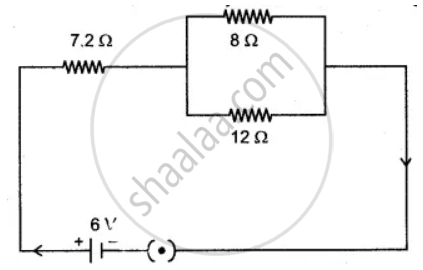
Calculate:
(i) the equivalent resistance of the circuit.
(ii) total current in the circuit.
(iii) potential difference across the 7.2 Ω resistor.
