Advertisements
Advertisements
प्रश्न
From a certain apparatus, the diffusion rate of hydrogen has an average value of 28.7 cm3 s–1. The diffusion of another gas under the same conditions is measured to have an average rate of 7.2 cm3 s–1. Identify the gas
[Hint: Use Graham’s law of diffusion: R1/R2 = (M2/M1)1/2, where R1, R2 are diffusion rates of gases 1 and 2, and M1 and M2 their respective molecular masses. The law is a simple consequence of kinetic theory.]
Advertisements
उत्तर १
Rate of diffusion of hydrogen, R1 = 28.7 cm3 s–1
Rate of diffusion of another gas, R2 = 7.2 cm3 s–1
According to Graham’s Law of diffusion, we have:
`R_1/R_2 = sqrt(M_2/M_1)`
Where,
M1 is the molecular mass of hydrogen = 2.020 g
M2 is the molecular mass of the unknown gas
`:. M_2 = M_1 (R_1/R_2)^2`
`= 2.02 (28.7/7.2)^2 = 32.09 g`
32 g is the molecular mass of oxygen. Hence, the unknown gas is oxygen.
उत्तर २
According to Graham’s law of diffusion of gases, the rate of diffusion of a gas is inversely proportional to the square root of its molecular mass.
If R1 and R2 be the rates of diffusion of two gases having molecular masses M1 and M2 respectively, then
`R_1/R_2 = sqrt(M_2/M_1)`
Now `R_1 = 28.7 cm^3 s^(-1), R_2 = 7.2 cm^3 s^(-1), M_1 = 2, M_2= ?`
`:. 28.7/7.2 = sqrt(M_2/2)`
`or M_2/2 = (28.7xx28.7)/(7.2xx7.2)`
or `M_2 = (2xx28.7xx28.7)/(7.2xx7.2) = 31.78 ~~ 32`
This molecular mass of oxygen.Therefore the second gas is oxygen.
APPEARS IN
संबंधित प्रश्न
While gas from a cooking gas cylinder is used, the pressure does not fall appreciably till the last few minutes. Why?
A gas is kept in a rigid cubical container. If a load of 10 kg is put on the top of the container, does the pressure increase?
If it were possible for a gas in a container to reach the temperature 0 K, its pressure would be zero. Would the molecules not collide with the walls? Would they not transfer momentum to the walls?
Figure shows graphs of pressure vs density for an ideal gas at two temperatures T1 and T2.
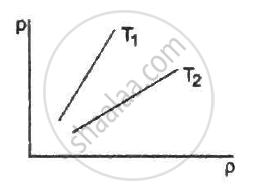
Equal masses of air are sealed in two vessels, one of volume V0 and the other of volume 2V0. If the first vessel is maintained at a temperature 300 K and the other at 600 K, find the ratio of the pressures in the two vessels.
Use R = 8.31 JK-1 mol-1
A vessel contains 1.60 g of oxygen and 2.80 g of nitrogen. The temperature is maintained at 300 K and the volume of the vessel is 0.166 m3. Find the pressure of the mixture.
Use R = 8.3 J K-1 mol-1
Is a slow process always isothermal? Is a quick process always adiabatic?
In an adiabatic process on a gas with γ = 1.4, the pressure is increased by 0.5%. The volume decreases by about
A vessel of volume V0 contains an ideal gas at pressure p0 and temperature T. Gas is continuously pumped out of this vessel at a constant volume-rate dV/dt = r keeping the temperature constant. The pressure of the gas being taken out equals the pressure inside the vessel. Find (a) the pressure of the gas as a function of time, (b) the time taken before half the original gas is pumped out.
Use R = 8.3 J K−1 mol−1
An ideal gas is kept in a long cylindrical vessel fitted with a frictionless piston of cross-sectional area 10 cm2 and weight 1 kg. The length of the gas column in the vessel is 20 cm. The atmospheric pressure is 100 kPa. The vessel is now taken into a spaceship revolving round the earth as a satellite. The air pressure in the spaceship is maintained at 100 kPa. Find the length of the gas column in the cylinder.
Use R = 8.3 J K-1 mol-1
The initial pressure and volume of a given mass of a gas (Cp/Cv = γ) are p0 and V0. The gas can exchange heat with the surrounding. (a) It is slowly compressed to a volume V0/2 and then suddenly compressed to V0/4. Find the final pressure. (b) If the gas is suddenly compressed from the volume V0 to V0/2 and then slowly compressed to V0/4, what will be the final pressure?
A barometer tube is 80 cm long (above the mercury reservoir). It reads 76 cm on a particular day. A small amount of water is introduced in the tube and the reading drops to 75.4 cm. Find the relative humidity in the space above the mercury column if the saturation vapour pressure at the room temperature is 1.0 cm.
A bucket full of water is placed in a room at 15°C with initial relative humidity 40%. The volume of the room is 50 m3. (a) How much water will evaporate? (b) If the room temperature is increased by 5°C, how much more water will evaporate? The saturation vapour pressure of water at 15°C and 20°C are 1.6 kPa and 2.4 kPa respectively.
Use R = 8.3 J K-1 mol-1
If 1022 gas molecules each of mass 10-26 kg collide with a surface (perpendicular to it) elastically per second over an area of 1 m2 with a speed of 104 m/s, the pressure exerted by the gas molecules will be of the order of ______.
In a cubical box of volume V, there are N molecules of a gas moving randomly. If m is mass of each molecule and v2 is the mean square of x component of the velocity of molecules, then the pressure of the gas is ______.
