From a solid cylinder of height 2.8 cm and diameter 4.2 cm, a conical cavity of the same height and same diameter is hollowed out. Find the total surface area of the remaining solid.
Advertisements
प्रश्न
From a solid cylinder of height 2.8 cm and diameter 4.2 cm, a conical cavity of the same height and same diameter is hollowed out. Find the total surface area of the remaining solid.
Advertisements
उत्तर
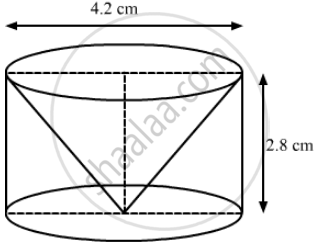
We have,
the height of the cone = the height of the cylinder = h =2.8 cm and the radius of the base, r = `4.2/2 = 2.1 "cm"`
The slant height of the cone, `l = sqrt(r^2 + h^2)`
`=sqrt(2.1^2 + 2.8^2)`
`= sqrt(4.41 +7.84)`
`=sqrt(12.25)`
= 3.5 cm
Now, the total surface area of the remaining solid = CSA of cylinder + CSA of cone + Area of base
`= 2pirh + pirl + pir^2`
`=pir (2h +l +r)`
`= 22/7 xx2.1xx(2xx2.8xx3.5+2.1)`
`= 22xx0.3xx(5.6+5.6)`
`=6.6xx 11.2`
`= 73.92 "cm"^2`
So, the total surface area of the remaining solid is 73.92 cm2.
APPEARS IN
संबंधित प्रश्न
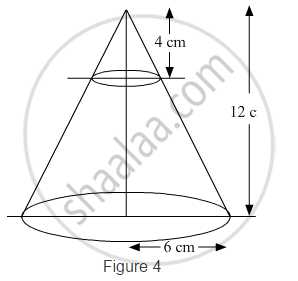
In Fig. 4, from the top of a solid cone of height 12 cm and base radius 6 cm, a cone of height 4 cm is removed by a plane parallel to the base. Find the total surface area of the remaining solid. (Use `pi=22/7` and `sqrt5=2.236`)
2 cubes each of volume 64 cm3 are joined end to end. Find the surface area of the resulting cuboid.
Water in a canal, 5.4 m wide and 1.8 m deep, is flowing with a speed of 25 km/hour. How much area can it irrigate in 40 minutes, if 10 cm of standing water is required for irrigation?
From a solid right circular cylinder of height 2.4 cm and radius 0.7 cm, a right circular cone of same height and same radius is cut out. Find the total surface area of the remaining solid.
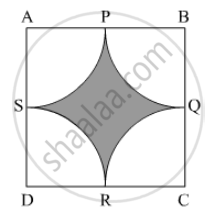
Find the area of the shaded region in Fig. 3, where arcs drawn with centres A, B, C and D intersect in pairs at mid-points P, Q, R and S of the sides AB, BC, CD and DA respectively of a square ABCD of side 12 cm. [Use π = 3.14]
A solid is in the form of a right circular cylinder, with a hemisphere at one end and a cone at the other end. The radius of the common base is 3.5 cm and the heights of the cylindrical and conical portions are 10 cm. and 6 cm, respectively. Find the total surface area of the solid. (Use π =`22/7`)
The perimeters of the ends of a frustum of a right circular cone are 44 cm and 33 cm. If the height of the frustum be 16 cm, find its volume, the slant surface and the total surface.
A tent consists of a frustum of a cone capped by a cone. If the radii of the ends of the frustum be 13 m and 7 m , the height of the frustum be 8 m and the slant height of the conical cap be 12 m, find the canvas required for the tent. (Take : π = 22/7)
A metallic cylinder has radius 3 cm and height 5 cm. To reduce its weight, a conical hole is drilled in the cylinder. The conical hole has a radius of `3/2` cm and its depth is `8/9 `cm. Calculate the ratio of the volume of metal left in the cylinder to the volume of metal taken out in conical shape.
If the radius of the base of a right circular cylinder is halved, keeping the height the same, then the ratio of the volume of the cylinder thus obtained to the volume of original cylinder is:
Two cubes each of volume 27 cm3 are joined end to end to form a solid. Find the surface area of the resulting cuboid.
A solid sphere of radius r is melted and cast into the shape of a solid cone of height r, the radius of the base of the cone is
A circus tent is cylindrical to a height of 4 m and conical above it. If its diameter is 105 m and its slant height is 40 m, the total area of the canvas required in m2 is
From a cubical piece of wood of side 21 cm, a hemisphere is carved out in such a way that the diameter of the hemisphere is equal to the side of the cubical piece. Find the surface area and volume of the remaining piece.
In a right circular cone, the cross-section made by a plane parallel to the base is a ______.
The volume of a hemisphere is 19404 cm3. The total surface area of the hemisphere is ______.
If two solid hemispheres of same base radius r are joined together along their bases, then curved surface area of this new solid is ______.
The boilers are used in thermal power plants to store water and then used to produce steam. One such boiler consists of a cylindrical part in middle and two hemispherical parts at its both ends.
Length of the cylindrical part is 7 m and radius of cylindrical part is `7/2` m.
Find the total surface area and the volume of the boiler. Also, find the ratio of the volume of cylindrical part to the volume of one hemispherical part.

The ratio of total surface area of a solid hemisphere to the square of its radius is ______.
