Advertisements
Advertisements
प्रश्न
Find the quotient and remainder of the following.
(8y3 – 16y2 + 16y – 15) ÷ (2y – 1)
Advertisements
उत्तर
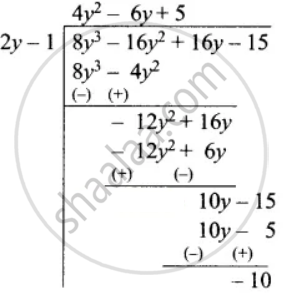
∴ The quotient = 4y2 – 6y + 5
The remainder = –10
APPEARS IN
संबंधित प्रश्न
Divide the polynomial p(x) by the polynomial g(x) and find the quotient and remainder in each of the following : p(x) = x4 – 3x2 + 4x + 5, g(x) = x2 + 1 – x
On dividing x3 – 3x2 + x + 2 by a polynomial g(x), the quotient and remainder were x – 2 and –2x + 4, respectively. Find g(x)
Apply division algorithm to find the quotient q(x) and remainder r(x) on dividing f(x) by g(x) in the following:
f(x) = x3 – 6x2 + 11x – 6, g(x) = x2 + x + 1
Apply division algorithm to find the quotient q(x) and remainder r(x) on dividing f(x) by g(x) in the following:
f(x) = 10x4 + 17x3 – 62x2 + 30x – 3, g(x) = 2x2 + 7x + 1
Find all zeros of the polynomial f(x) = 2x4 – 2x3 – 7x2 + 3x + 6, if its two zeros are `-sqrt(3/2)` and `sqrt(3/2)`.
Find all the zeros of the polynomial x4 + x3 – 34x2 – 4x + 120, if two of its zeros are 2 and –2.
Find all the zeros of the polynomial 2x3 + x2 – 6x – 3, if two of its zeros are `-sqrt(3)` and `sqrt(3)`.
It is given that –1 is one of the zeroes of the polynomial x3 + 2x2 – 11x – 12. Find all the zeroes of the given polynomial.
Find the quotient and remainder of the following.
(4x3 + 6x2 – 23x + 18) ÷ (x + 3)
Find k so that x2 + 2x + k is a factor of 2x4 + x3 – 14 x2 + 5x + 6. Also find all the zeroes of the two polynomials.
