Advertisements
Advertisements
प्रश्न
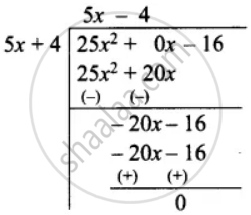
The base of a parallelogram is (5x + 4). Find its height if the area is 25x2 – 16
Advertisements
उत्तर
Let the height of the parallelogram be “h”
Base of the parallelogram = 5x + 4
Area of a parallelogram = 25x2 – 16
∴ Base × Height = 25x2 – 16
(5x + 4) × h = 25x2 – 16
h = `(25x^2 - 16)/(5x + 4)`
h = `((5x)^2 - 4^2)/(5x + 4)`
= `((5x + 4)(5x - 4))/(5x + 4)`
Height of the parallelogram = 5x – 4
APPEARS IN
संबंधित प्रश्न
Check whether the first polynomial is a factor of the second polynomial by dividing the second polynomial by the first polynomial
x2 + 3x + 1, 3x4 + 5x3 – 7x2 + 2x + 2
Check whether the first polynomial is a factor of the second polynomial by dividing the second polynomial by the first polynomial.
x3 – 3x + 1, x5 – 4x3 + x2 + 3x + 1
Give examples of polynomials p(x), g(x), q(x) and r(x), which satisfy the division algorithm
deg p(x) = deg q(x)
Give examples of polynomials p(x), g(x), q(x) and r(x), which satisfy the division algorithm
deg r(x) = 0
If the polynomial x4 – 6x3 + 16x2 – 25x + 10 is divided by another polynomial x2 – 2x + k, the remainder comes out to be x + a, find k and a.
Obtain all zeros of f(x) = x3 + 13x2 + 32x + 20, if one of its zeros is –2.
Find all the zeros of the polynomial x3 + 3x2 – 2x – 6, if two of its zeros are `-sqrt(2)` and `sqrt(2)`.
If x3 + x2 – ax + b is divisible by (x2 – x), write the values of a and b.
The sum of (x + 5) observations is (x3 + 125). Find the mean of the observations
Find k so that x2 + 2x + k is a factor of 2x4 + x3 – 14 x2 + 5x + 6. Also find all the zeroes of the two polynomials.
