Advertisements
Advertisements
प्रश्न
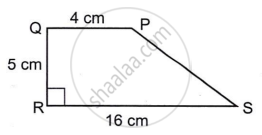
Find the perimeter and area of trapezium PQRS.
Advertisements
उत्तर
Given that the trapezium PQRS has the dimensions:
- PQ = 4 cm
- QR = 5 cm ...(Perpendicular height)
- SR = 16 cm
Stepwise calculation:
1. The segment PS is not calculated by diagonal length from the triangle PQS. Instead, recognize that trapezium PQRS contains a rectangle QRPQ (4 cm by 5 cm) and a right triangle formed by PS, SR and the leftover horizontal segment.
2. From the figure, since QR = 5 cm is perpendicular and PQ = 4 cm is horizontal, the total length along the base SR (16 cm) minus the base PQ (4 cm) gives the length of the bottom right segment adjacent to PS as (16 – 4) = 12 cm.
3. Given PS is perpendicular to SR common assumption or can be inferred, then PS is the hypotenuse of a right triangle with sides QR = 5 cm and the difference segment = 12 cm.
4. Calculate PS:
`PS = sqrt(QR^2 + (SR - PQ)^2)`
= `sqrt(5^2 + 12^2)`
= `sqrt(25 + 144)`
= `sqrt(169)`
= 13 cm
5. Now calculate the perimeter by summing all sides:
Perimeter = PQ + QR + SR + PS
= 4 + 5 + 16 + 13
= 38 cm
6. The area is calculated as the average length of the parallel sides multiplied by the height QR:
Area = `1/2` × PQ + SR × QR
= `1/2` × 4 + 16 × 5`
= `1/2` × 20 × 5`
= 50 cm2
Perimeter of trapezium PQRS = 38 cm.
Area of trapezium PQRS = 50 cm2.
