Advertisements
Advertisements
प्रश्न
Find the derivatives of the following functions with respect to corresponding independent variables:
Draw the function f'(x) if f(x) = 2x2 – 5x + 3
Advertisements
उत्तर
f(x) = 2x2 – 5x + 3
f'(x) = 4x – 5 which is a linear function
(i.e.) y = 4x – 5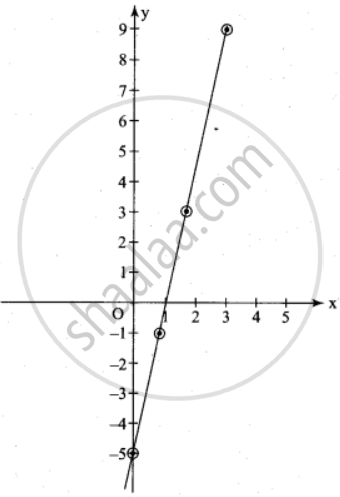
| x | 0 | 1 | 2 | 3 |
| y | – 5 | – 1 | 3 | 7 |
APPEARS IN
संबंधित प्रश्न
Find the derivatives of the following functions with respect to corresponding independent variables:
g(t) = t3 cos t
Find the derivatives of the following functions with respect to corresponding independent variables:
g(t) = 4 sec t + tan t
Find the derivatives of the following functions with respect to corresponding independent variables:
y = `sinx/(1 + cosx)`
Find the derivatives of the following functions with respect to corresponding independent variables:
y = (x2 + 5) log(1 + x) e–3x
Differentiate the following:
f(t) = `root(3)(1 + tan "t")`
Differentiate the following:
y = (2x – 5)4 (8x2 – 5)–3
Differentiate the following:
y = `(x^2 + 1) root(3)(x^2 + 2)`
Differentiate the following:
s(t) = `root(4)(("t"^3 + 1)/("t"^3 - 1)`
Differentiate the following:
y = tan (cos x)
Differentiate the following:
y = `sqrt(x + sqrt(x + sqrt(x)`
Differentiate the following:
y = `sin^-1 ((1 - x^2)/(1 + x^2))`
Find the derivatives of the following:
y = `x^(cosx)`
Find the derivatives of the following:
`x^2/"a"^2 + y^2/"b"^2` = 1
Find the derivatives of the following:
`tan^-1sqrt((1 - cos x)/(1 + cos x)`
Find the derivatives of the following:
`tan^-1 = ((6x)/(1 - 9x^2))`
Find the derivatives of the following:
Find the derivative of sin x2 with respect to x2
Find the derivatives of the following:
If x = a(θ + sin θ), y = a(1 – cos θ) then prove that at θ = `pi/2`, yn = `1/"a"`
Choose the correct alternative:
If y = `1/4 u^4`, u = `2/3 x^3 + 5`, then `("d"y)/("d"x)` is
Choose the correct alternative:
If x = a sin θ and y = b cos θ, then `("d"^2y)/("d"x^2)` is
Choose the correct alternative:
The differential coefficient of `log_10 x` with respect to `log_x 10` is
