हिंदी

Find the Equation of the Plane Which Contains the Line of Intersection of the Planes `Vecrr.(Hati + 2hatj + 3hatk) - 4 = 0, Vecr.(2hati + Htj - Hatk) + 5`, And Which is Perpendicular to the Plane `Vecr.(5hati + 3hatj - 6hatk) + 8 = 0 - Mathematics

Advertisements
Advertisements

प्रश्न

Find the equation of the plane which contains the line of intersection of the planes `vecrr.(hati + 2hatj + 3hatk) - 4 = 0, vecr.(2hati + htj - hatk) + 5 = 0`,  and which is perpendicular to the plane `vecr.(5hati + 3hatj - 6hatk) + 8 = 0`.

Advertisements

उत्तर

The equations of the given planes are

`vecrr.(hati + 2hatj + 3hatk) - 4 = 0` ...(1)

`vecr.(2hati + htj - hatk) + 5 = 0`  ...(2)

The equation of the plane passing through the line intersection of the plane given in equation (1) and equation (2) is
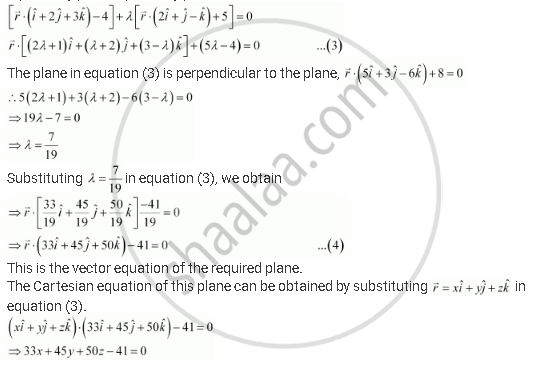
shaalaa.com
  क्या इस प्रश्न या उत्तर में कोई त्रुटि है?
अध्याय 11: Three Dimensional Geometry - Exercise 11.4 [पृष्ठ ४९८]

APPEARS IN

एनसीईआरटी Mathematics Part 1 and 2 [English] Class 12
अध्याय 11 Three Dimensional Geometry
Exercise 11.4 | Q 17 | पृष्ठ ४९८

संबंधित प्रश्न

Find the equation of the plane passing through the line of intersection of the planes `vecr.(hati + hatj + hatk) = 1` and `vecr.(2hati + 3hatj -hatk) + 4 = 0` and parallel to x-axis.


Find the equation of the plane through the intersection of the planes 3x − 4y + 5z = 10 and 2x + 2y − 3z = 4 and parallel to the line x = 2y = 3z.


Find the distance of the point (2, 12, 5) from the point of intersection of the line \[\vec{r} = 2 \hat{i}  - 4 \hat{j}+ 2 \hat{k}  + \lambda\left( 3 \hat{i}  + 4 \hat{j}  + 2 \hat{k} \right)\] and \[\vec{r} . \left( \hat{i}  - 2 \hat{j}  + \hat{k}  \right) = 0\]


Find the distance of the point P(−1, −5, −10) from the point of intersection of the line joining the points A(2, −1, 2) and B(5, 3, 4) with the plane  \[x - y + z = 5\] . 


Find the distance of the point (1, -5, 9) from the plane

\[x - y + z =\] 5  measured along the line \[x = y = z\]  . 
 

Find the equation of the plane containing the line \[\frac{x + 1}{- 3} = \frac{y - 3}{2} = \frac{z + 2}{1}\]  and the point (0, 7, −7) and show that the line  \[\frac{x}{1} = \frac{y - 7}{- 3} = \frac{z + 7}{2}\] also lies in the same plane.


Find the equation of the plane determined by the intersection of the lines \[\frac{x + 3}{3} = \frac{y}{- 2} = \frac{z - 7}{6} \text{ and  }\frac{x + 6}{1} = \frac{y + 5}{- 3} = \frac{z - 1}{2}\]


Find the coordinates of the point where the line \[\frac{x - 2}{3} = \frac{y + 1}{4} = \frac{z - 2}{2}\] intersect the plane x − y + z − 5 = 0. Also, find the angle between the line and the plane.


Find the distance of the point with position vector

\[- \hat{i}  - 5 \hat{j}  - 10 \hat{k} \]  from the point of intersection of the line \[\vec{r} = \left( 2 \hat{i}  - \hat{j}  + 2 \hat{k}  \right) + \lambda\left( 3 \hat{i}  + 4 \hat{j}  + 12 \hat{k}  \right)\]  with the plane \[\vec{r} \cdot \left( \hat{i} - \hat{j}+ \hat{k}  \right) = 5 .\]
 

The plane 2x − (1 + λ) y + 3λz = 0 passes through the intersection of the planes


The equation of the plane through the intersection of the planes x + 2y + 3z = 4 and 2x + y − z = −5 and perpendicular to the plane 5x + 3y + 6z + 8 = 0 is


The equation of the plane through the line x + y + z + 3 = 0 = 2x − y + 3z + 1 and parallel to the line \[\frac{x}{1} = \frac{y}{2} = \frac{z}{3}\] is 


A plane meets the coordinate axes at AB and C such that the centroid of ∆ABC is the point (abc). If the equation of the plane is \[\frac{x}{a} + \frac{y}{b} + \frac{z}{c} = k,\] then k = 


The distance of the point (−1, −5, −10) from the point of intersection of the line \[\vec{r} = 2 \hat{i}- \hat{j} + 2 \hat{k}  + \lambda\left( 3 \hat{i}  + 4 \hat{j}+ 12 \hat{k}  \right)\]   and the plane \[\vec{r} \cdot \left( \hat{i} - \hat{j} + \hat{k}  \right) = 5\] is 


The equation of the plane through the intersection of the planes ax + by + cz + d = 0 andlx + my + nz + p = 0 and parallel to the line y=0, z=0


The equation of the plane which cuts equal intercepts of unit length on the coordinate axes is


Find the equation of the plane passing through the intersection of the planes `vecr . (hati + hatj + hatk)` and `vecr.(2hati + 3hatj - hatk) + 4 = 0` and parallel to the x-axis. Hence, find the distance of the plane from the x-axis.


Show that the lines `("x"-1)/(3) = ("y"-1)/(-1) = ("z"+1)/(0) = λ and  ("x"-4)/(2) = ("y")/(0) = ("z"+1)/(3)` intersect. Find their point of intersection. 


Show that the lines `(x - 1)/2 = (y - 2)/3 = (z - 3)/4` and `(x - 4)/5 = (y - 1)/2` = z intersect. Also, find their point of intersection.


Prove that the line through A(0, – 1, – 1) and B(4, 5, 1) intersects the line through C(3, 9, 4) and D(– 4, 4, 4).


Find the equation of the plane which is perpendicular to the plane 5x + 3y + 6z + 8 = 0 and which contains the line of intersection of the planes x + 2y + 3z – 4 = 0 and 2x + y – z + 5 = 0.


Find the equation of line parallel to the y-axis and drawn through the point of intersection of x – 4y + 1 = 0 and 2x + y – 7 = 0.


ABCD be a parallelogram and M be the point of intersection of the diagonals, if O is any point, then OA + OB + OC + OD is equal to


The equation of straight line through the intersection of the lines x – 2y = 1 and x + 3y = 2 and parallel to 3x + 4y = 0 is


The equation of the curve passing through the point `(0, pi/4)` whose differential equation is sin x cos y dx + cos x sin y dy = 0, is


Share
Notifications

Englishहिंदीमराठी


      Forgot password?
Use app×