Advertisements
Advertisements
प्रश्न
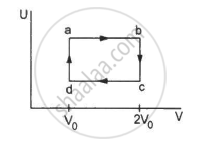
Figure shows the variation in the internal energy U with the volume V of 2.0 mol of an ideal gas in a cyclic process abcda. The temperatures of the gas at b and c are 500 K and 300 K respectively. Calculate the heat absorbed by the gas during the process.
Advertisements
उत्तर
Given: Number of moles of the gas, n = 2 moles
The system's volume is constant for lines bc and da.
Therefore,
∆V = 0
Thus, work done for paths da and bc is zero.
⇒ Wda = Wbc = 0
Since the process is cyclic, ∆U is equal to zero.
Using the first law, we get
∆W = ∆Q
∆W = ∆WAB + ∆WCD
Since the temperature is kept constant during lines ab and cd, these are isothermal expansions.
Work done during an isothermal process is given by
W = nRT
\[\ln\frac{V_f}{V_i}\]
If Vf and Vi are the initial and final volumes during the isothermal process, then
\[W = n {RT}_1 ln\left( \frac{2 V_0}{V_0} \right) + n {RT}_2 ln\left( \frac{V_0}{2 V_0} \right)\]
W = nR × 2.303 × log 2 × (500 − 300)
W = 2 × 8.314 × 2.303 × 0.301 × 200
W = 2305.31 J
