Advertisements
Advertisements
प्रश्न
External dimensions of a closed wooden box are in the ratio 5:4:3. If the cost of painting its outer surface at the rate of Rs 5 per dm2 is Rs 11,750, find the dimensions of the box.
Advertisements
उत्तर
External dimensions of a closed wooden box are in the ratio 5:4:3.
Let the external dimensions of the closed wooden box be 5x, 4x and 3x.
The cost of painting = ₹ 5 per dm2
Total cost of painting = ₹ 11750
∴ Total surface area = `"Total cost of painting"/("Cost of painting per dm"^2) = 11750/5`
Total surface area of a cuboid = 2(lb + bh + hl)
= 2(5x × 4x + 4x × 3x + 3x × 5x)
= 2(20x2 + 12x2 + 15x2)
= 2 × 47x2
= 94x2
Since, total surface area = 2350 dm2
⇒ 94x2 = 2350
⇒ `x^2 = 2350/94 = 25`
∴ x = 5
Hence, dimensions of the box are 5x × 5 = 25 dm, 4x × 5 = 20 dm and 3x × 5 = 15 dm.
APPEARS IN
संबंधित प्रश्न
There are two cuboidal boxes as shown in the adjoining figure. Which box requires the lesser amount of material to make?
 |
 |
| (a) | (b) |
The volume of a cuboidal box is 48 cm3. If its height and length are 3 cm and 4 cm respectively, find its breadth.
Find the volume in cubic metre (cu. m) of the cuboid whose dimensions is length = 10 m, breadth = 25 dm, height = 50 cm.
How many planks each of which is 3 m long, 15 cm broad and 5 cm thick can be prepared from a wooden block 6 m long, 75 cm broad and 45 cm thick?
If each edge of a cube, of volume V, is doubled, then the volume of the new cube is
The cost of constructing a wall 8 m long, 4 m high and 10 cm thick at the rate of Rs. 25 per m3 is
The length breadth and height of a cuboid are in the ratio of 3 : 3 : 4. Find its volume in m3 if its diagonal is `5sqrt(34)"cm"`.
Three identical cubes of side 4 cm are joined end to end. Find the total surface area and lateral surface area of the new resulting cuboid
All six faces of a cuboid are ______ in shape and of ______ area.
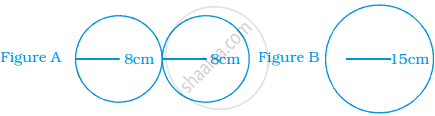
Below are the drawings of cross sections of two different pipes used to fill swimming pools. Figure A is a combination of 2 pipes each having a radius of 8 cm. Figure B is a pipe having a radius of 15 cm. If the force of the flow of water coming out of the pipes is the same in both the cases, which will fill the swimming pool faster?