Advertisements
Advertisements
प्रश्न
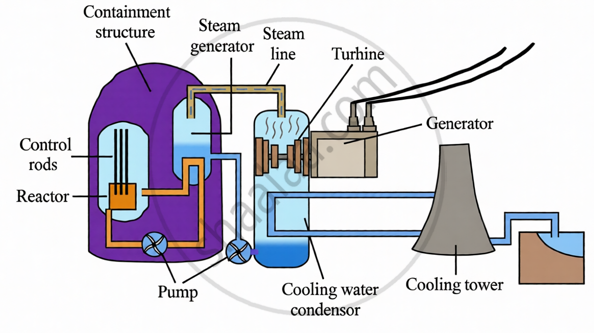
Explain with a diagram the step-by-step energy conversion in a nuclear power plant.
Advertisements
उत्तर
In a nuclear power plant, energy is released by the fission of the nuclei of radioactive elements such as uranium or plutonium. This energy is used to produce steam at high temperature and pressure. The kinetic energy of the steam rotates the turbine. The rotating turbine drives the generator, which produces electricity.
Energy conversion:
Nuclear Energy → Thermal Energy → Kinetic Energy → Mechanical Energy → Electrical Energy.
APPEARS IN
संबंधित प्रश्न
What is nuclear fission? Explain with an example. Write the equation of the nuclear reaction involved.
State the disadvantages of nuclear energy.
Name five places in India where nuclear power plants are located.
Differentiate between nuclear fission and nuclear fusion.
Calculate the energy released in joules when 5 g of a material is completely converted into energy doing a nuclear reaction.
The mass numbers of four elements A, B, C and D are 2, 20, 135 and 235, respectively. Which one of them will be most suitable to make:
(i) an atom bomb,
An element P has an atomic mass of 239 and an atomic number of 92. It
emits a beta particle forming an element Q. Q can be represented by
In what way are these numbers related to the isotopes of an element?
Assertion (A): In the process of nuclear fission, the amount of nuclear energy generated by the fission of an atom of uranium is so tremendous that it produces 10 million times the energy produced by the combustion of an atom of carbon from coal.
Reason (R): The nucleus of a heavy atom such as uranium, when bombarded with low energy neutrons, splits apart into lighter nuclei. The mass difference between the original nucleus and the product nuclei gets converted to tremendous energy.
What safety measures and needed in a nuclear power plant?
What is nuclear waste? What are hazard of nuclear waste to living beings? How is nuclear waste disposed off?
Hydroelectric power station : Water stored in dams : : Nuclear power station : ____________
Which substance is used as fuel in nuclear power plants?
Why are control rods used in nuclear reactors?
Write a short note.
Nuclear Power Plant
In atomic power station, ______ is used to rotate the turbine.
Give scientific reason.
It is absolutely necessary to control the fission reaction in nuclear power plants.
Give scientific reasons.
It is absolutely necessary to control the fission reaction in nuclear power plants.
Copy and complete the nuclear reaction by filling in the blanks.
\[\ce{_92U^235 + _0n^1 -> _56Ba^{\underline{\phantom{....}}} + \underline{\phantom{..}}Kr^92 + 3 _0n^1}\]
Express 1 a.m.u. in MeV.
