Advertisements
Advertisements
प्रश्न
Explain the Structure of Diborane.
Advertisements
उत्तर
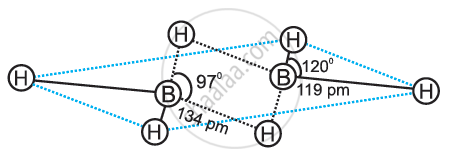
B2H6 is an electron-deficient compound. B2H6 has only 12 electrons – 6 e– from 6 H atoms and 3 e– each from 2 B atoms. Thus, after combining with 3 H atoms, none of the boron atoms has any electrons left. X-ray diffraction studies have shown the structure of diborane as:

2 boron and 4 terminal hydrogen atoms (Ht) lie in one plane, while the other two bridging hydrogen atoms (Hb) lie in a plane perpendicular to the plane of boron atoms. Again, of the two bridging hydrogen atoms, one H atom lies above the plane and the other lies below the plane. The terminal bonds are regular two-centre two-electron (2c – 2e–) bonds, while the two bridging (B–H–B) bonds are three-centre two-electron (3c – 2e–) bonds.
संबंधित प्रश्न
Explain what happens when boric acid is heated.
Explain the Structure of Boric Acid.
Boric acid is polymeric due to ______.
Draw the structures of BCl3.NH3 and AlCl3 (dimer).
Explain the nature of boric acid as a Lewis acid in water.
Draw the structure of boric acid showing hydrogen bonding. Which species is present in water? What is the hybridisation of boron in this species?
What are boranes? Give chemical equation for the preparation of diborane.
A compound (A) of boron reacts with NMe3 to give an adduct (B) which on hydrolysis gives a compound (C) and hydrogen gas. Compound (C) is an acid. Identify the compounds A, B and C. Give the reactions involved.
Which of the following is a FALSE statement about boric acid, \[\ce{H3BO3}\]?
Which is correct statement about diborane structure?
Diborane (B2H6) reacts independently with O2 and H2O to produce, respectively:
Which of the following compounds are formed when boron trichloride is treated with water?
In diborane ______.
Boron reacts with nitric acid to form ______.
Which one of the following methods is used to prepare borax crystals?
Boric acid (H3BO3) is ______.
The reaction of H3N3B3Cl3(A) with LiBH4 in tetrahydrofuran gives inorganic benzene (B). Further, the reaction of (A) with (C) leads to H3N3B3(Me)3. Compounds (B) and (C) respectively, are ______.
