Explain the principle of dialysis with the help of a labelled diagram.
Advertisements
प्रश्न
Explain the principle of dialysis with the help of a labelled diagram.
Advertisements
उत्तर
Principle of dialysis:

The procedure of dialysis is based on the diffusion of solutes and the ultrafiltration of fluid across a semi-permeable membrane. In dialysis, the blood from a convenient artery is pumped into the dialyser of a dialysing machine. A dialyser contains a coiled cellophane tube surrounded by the dialysing solution. The dialysing solution contains water, glucose and salts, which are similar in concentration to those in normal blood. The porous cellophane membrane of the tube allows the passage of molecules based on concentration gradient. As the patient’s blood passes through the dialysing solution, most of the waste products (like urea) present in it pass through the selectively permeable cellulose tubes into the dialysing solution, thereby cleaning the blood. The clean blood is pumped back to the body through a vein.
APPEARS IN
संबंधित प्रश्न
What are the methods used by plants to get rid of excretory products?
Name the two parts of a plant through which its gaseous waste products are released into the air.
Gums and resins are the ______ products of plants.
Describe the mechanism of urine formation in human excretory system. Draw a labelled diagram to illustrate your answer.
Answer the following in short.
List five waste products of plants.
Name the following:
The outer region of kidney containing the Bowman's capsule.
Write down the functional activity of the following parts,
Renal artery ………………
Fill in the blanks in the following passage to make it a meaningful description.
In a nephron, the ______ flows through the ______ under great pressure. The reason for this great pressure is that the ______ (outgoing) ______ is narrower than the ______ (incoming). This high pressure causes the ______ part of the blood to filter out from the ______ into the ______ capsule.
Look at the figure given bellow, it is a section of human kidney as seen from the front.

Is it a longitudinal section or a cross-section?
The following diagram represents a mammalian kidney tubule (nephron) and its blood supply.

Parts indicated by the guidelines 1 to 8 are as follows:
1. Afferent arteriole from renal artery
2. efferent arteriole
3. Bowman’s capsule
4. Glomerulus;
5. Proximal convoluted tubule with blood capillaries;
6. Distal convoluted tubule with blood capillaries;
7. collecting tubule;
8. U-shaped loop of Henle
Study the diagram and answer the question that follow:
Where does ultrafiltration take place?
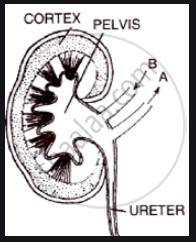
Given below is a highly simplified diagram of the human kidney cut open longitudinally. Answer the question that follow:
Name the functional units of the kidneys.
Complete the following sentence with appropriate word:
The sum total of all the chemical reactions taking place in the cell is known as ______.
State the Location: Renal pyramids
Write the functional activity of the following structure: Aldosterone
Write the functional activity of the following structure:
Glomerulus
Among the following animals, the best conserver of water is ______.
Certain organisms that are aquatic in habitat, tolerate only a narrow range of salinity. What term is given to such animals?
Which of the following is not an example of secretion?
An organ that produces urea:
Give reason:
Excretion is a necessary process of our body.
