Advertisements
Advertisements
प्रश्न
Explain the mechanism of reflex action with the help of a suitable diagram.
Advertisements
उत्तर
Mechanism of Reflex action : The reflex action is completed in a series of events. The events that occur are,
(1) Pricking of needle stimulates skin receptors by receiving stimulus,
(2) Sensory impulse is formed and it is carried by denderites innervating the skin.
(3) Impulse is carried to the association neuron by axon of sensory neuron,
(4) When impulse reaches the end of the axon there is a synapse.

(5) Synaptic transmission is chemical: The synaptic buttons at the end of the axon releases a neurotransmitter substance acetylcholine. It fills the synaptic gap and helps in chemical transmission of the impulse from axon of one neuron to dendron of the other neuron. Once the impulse reaches the dendrites of association neuron, axonic buttons release an enzyme acetylcholine estrase which neutralizes the acetycholine and again a synaptic gap is formed. This mechanism helps to receive new impulse or avoid the mixing of different impules.
(6) The association neuron receive sensory impulse, interprets it, analyses it and generates motor impulse.
(7) Motor impulse again travels through synapse between association neuron and motor neuron.
(8) Impulse travels through motor neuron and reaches effector organ like skeletal muscles or the gland.
(9) The effector organ gives a proper response like contraction of the muscles or secretion by the gland.
For e.g., when the hand is pricked with a needle, immediately hand is withdrawn from the source.
APPEARS IN
संबंधित प्रश्न
Name one gustatory receptor and one olfactory receptor present in human beings.
The diagram given below shows the internal structure of a spinal cord depicting a phenomena. Study the diagram and answer the questions:
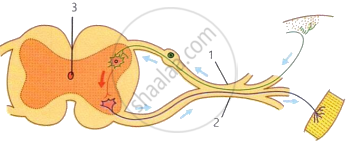
- Name the phenomenon that is depicted in the diagram. Define the phenomenon.
- Give the technical term for the point of contact between the two nerve cells.
- Name the parts numbered 1, 2 and 3.
- How does the arrangement of neurons in the spinal cord differ from that of the brain?
- Mention two ways by which the spinal cord is protected in our body.
Which of the following cannot be considered a receptor?
(a) ear
(b) nose
(c) muscle
(d) eye
Which of the following statements are true?
(i) sudden action in response to something in the environment is called reflex action
(ii) sensory neurons carry electrical signals from spinal cord to muscles in a reflex action
(iii) motor neurons carry signals from receptors to spinal cord in a reflex action
(iv) the pathway of transmitting signals from a receptor to a muscle is a reflex action
With the help of suitable example, describe reflex action.
Mention, if the following statement is True or False
Reflex action involves brain
Complete the following sentence with appropriate Word
The control of reflex action is through:
What will you do if someone pricks your hand with a needle? Elucidate the pathway of response with a neat labelled diagram.
