Advertisements
Advertisements
प्रश्न
Explain the difference between a transparent, a translucent, and an opaque medium. Give two examples of each.
Advertisements
उत्तर
1. Transparent objects: Those objects through which light can pass easily are called transparent objects. e.g. Water, glass, air.
2. Translucent object: The object through which light can pass partially are called translucent object, e.g. tracing paper, waxed paper.
3. Opaque object: The objects which do not allow the light to pass through are called opaque objects, e.g. wood.
APPEARS IN
संबंधित प्रश्न
Write true or false of the following statement.
Light travels in a straight-line path.
What do we call a substance through which we cannot see light? Give an example of such a substance.
What do you understand by candle power?
The sun and ______ are the natural sources of light.
Match the following.
| Group A | Group B |
| (a) Mirror | (1) Non-luminous |
| (b) Firefly | (2) Inverted image |
| (c) Pinhole camera | (3) Reflection |
| (d) Moon | (4) Luminous |
State whether true or false. If false, correct the statement.
If a ray of light passes obliquely from one medium to another, it does not suffer any deviation.
The mirror used in search light is ______.
Boojho and Paheli were given one mirror each by their teacher. Boojho found his image to be erect and of the same size whereas Paheli found her image erect and smaller in size. This means that the mirrors of Boojho and Paheli are, respectively
Light is a form of energy and it travels in a straight line.
Look at the figure given in the following figure.
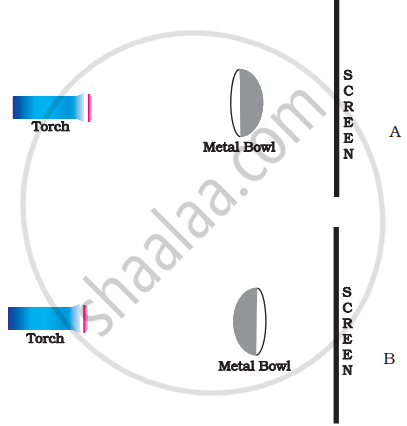
Will there be any difference in the shadow formed on the screen in A and B.
