Advertisements
Advertisements
प्रश्न
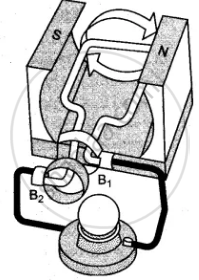
Explain the construction and working of the following. Draw a neat diagram and label it.
Electric Generator (AC)
Advertisements
उत्तर
Electric Generator principle: An electric generator is a machine that generates electricity by rotating its motor in a magnetic field. Thus, it converts mechanical energy into electrical energy.
Construction: A generator consists of a rectangular coil MNST of insulated copper wire placed between two strong magnetic poles. The two ends of the coil MNST are connected with brushes A and B of rings C and D respectively. The inner sides of the rings are insulated. They are attached with an axle X, which can be rotated mechanically. Brushes A and B are connected with a galvanometer that can measure the flow of current in coil MNST.
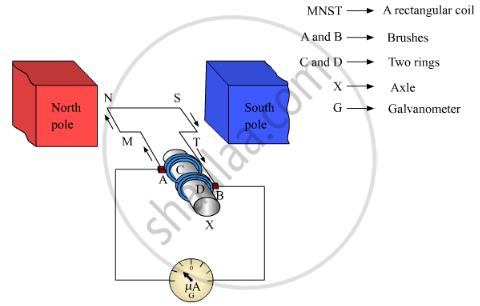
Working: When the axle is rotated, lengths MN and ST move up and down respectively. Since lengths MN and ST are moving in a magnetic field, a current gets induced in these lengths caused by an electromagnetic induction. The direction of the induced current in both the lengths is given by Fleming’s right hand rule.
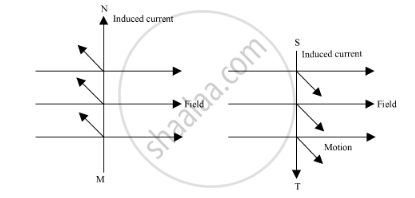
Since length MN is moving upwards in the magnetic field that acts from left to right, the direction of the induced current will be from M to N. Similarly, the direction of the induced current in length ST will be from S to T. Hence, an induced current will set up in the coil in the direction MNST, which produces deflection in the galvanometer.
After half-rotation, length MN starts moving down, whereas length ST starts moving up. The direction of the induced current in the coil gets reversed, i.e., the induced current will now flow from T to M via S and N, i.e., TSNM. Therefore, we can conclude that after each half-rotation, the direction of the induced current is reversed. This current is called an alternating current (AC). An AC reverses its direction after equal time intervals.
APPEARS IN
संबंधित प्रश्न
A rectangular coil of copper wires is rotated in a magnetic field. The direction of the induced current changes once in each______.
The essential difference between an AC generator and a DC generator is that
What change should be made in an a.c. generator so that it may become a d.c. generator?
The frequency of alternating current (a.c.) supply in India is ______.
Draw a labelled diagram of a simple a.c. generator.
State one advantage of using a.c. over d.c.
Draw a neat labeled diagram of an A.C. generator
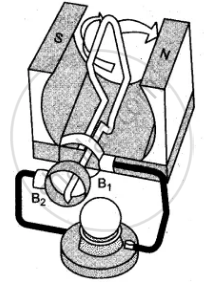
The given figures 1 to 3 show the working of a simple A.C. generator. Study the diagrams and answers of the following questions.
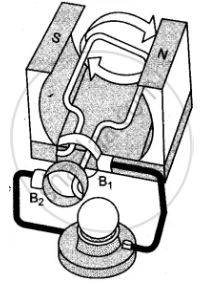
(i) State and explain the principle underlying the working of a simple generator.
(ii) Where is the loop of wire placed?
(iii) What happens when the loop is rotated?
(iv) Indicate the direction of the current flow through the wire for the first half of the turn (in first figure). Name and state the rule used in finding the direction of the current.
(v) Indicate the direction of the current for the case shown in second figure.
(vi) Indicate the direction of current in the outer circuit (i.e., electric bulb) in first and third figure.
(vii) What type of current is shown in the above diagrams? Explain.
Draw and label the diagram of an AC generator.
A coil of insulated copper wire is connected to a galvanometer. What will happen if a bar magnet is withdrawn from inside the coil?
Observe the following diagram and answer the questions.

- Explain the construction of the equipment shown in the figure.
- How is AC generated?
Which principle is used by an a.c. generator to produce electrical energy?
Under what condition is an EMF induced in a closed coil?
What type of current flows in the external load?
What is the magnetic flux through one turn at time \[t\]?
What EMF results from differentiating the total flux linkage?
How is angular speed related to frequency of rotation \[n\]?
What is the frequency of rotation of the stationary-bicycle generator's coil?
