Advertisements
Advertisements
प्रश्न
Explain the concept of Calcination.
Advertisements
उत्तर
In the calcination process, carbonate ores are strongly heated in a limited supply of air to transform them into oxides. In this process, carbonate ores decompose to form a metal oxide and carbon dioxide gas.
APPEARS IN
संबंधित प्रश्न
In the electrolytic refining of a metal M, what would you take as anode, cathode and electrolyte?
Give a reasons for the following:
Carbonate and sulphide ores are usually converted into oxides during the process of extraction of metals.
In the extraction of aluminium: Why is it necessary to replace anodes time to time?
Silver metal does not combine easily with oxygen but silver jewellery tarnishes after some time. How?
Name one metal which is extracted by:
Electrolytic reduction.
How is manganese extracted from manganese dioxide, MnO2? Explain with the help of an equation.
Which of the following metals can be obtained from haematite ore?
State three objectives achieved during the roasting of ores.
State one observation for each of the following :
Copper sulphate solution is electrolysed using copper electrodes.
Give the chemical formula of :
Cryolite
Answer the following questions based on the extraction of aluminium from alumina by Hall - Heroult’s Process :
What is the function of cryolite used along with alumina as the electrolyte?
Complete the incomplete statement with missing word:
Metals are malleable while non-metals are ______.
Name the following:
The process of heating an ore to a high temperature in the presence of air.
State the property of the metal being utilized in the following :
| Use of metal | Property |
| Zinc in Galvanization | |
| Aluminium in Thermite welding |
Define calcination.
Observe the given figure of reactivity series of metals and answer the following questions:
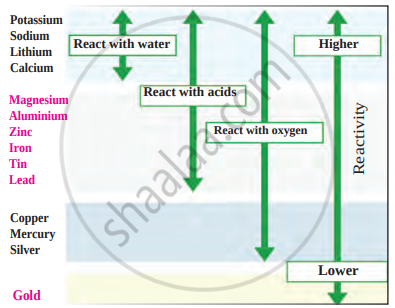
Reactivity series of metals
- Name two metals which react with water.
- Name two moderately reactive metals.
- Name the most highly reactive metal and the most less reactive metal.
Bauxite reacts with sodium hydroxide in the Bayer’s process.
Write the molecular formulae of the following compound.
Sodium aluminate
The highly reactive metals like Sodium, Potassium, Magnesium, etc. are extracted by the ____________.
In thermite welding a mixture of ____________ is ignited with a burning magnesium ribbon which produces molten iron metal as a large amount of heat is evolved.
