Advertisements
Advertisements
प्रश्न
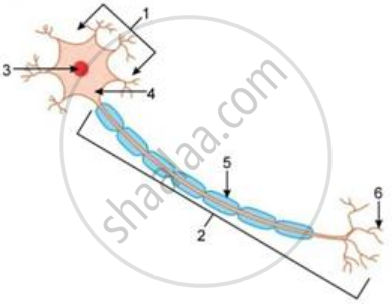
Explain the structure of neuron with the help of a labelled diagram.
Advertisements
उत्तर
Structure of neuron:

A neuron is the building material of the nervous tissue. Neurons are involved in conducting impulses to different parts of the body on receiving an external or internal stimuli. It consists of the following three parts:
(i) Cyton:
It refers to the cell body of neuron and is composed of nucleus and cytoplasm. Clumps of ribosomes called Nissl's granules are distributed in its cytoplasm.
(ii) Dendron:
They are short processes that arise from the cell body. They get further branched into dendrites.
(iii) Axon (nerve fibre):
It is the long and cylindrical part of the cell that forms fine branches terminally. Each branch of axon is swollen at an end, forming a synaptic knob (bouton) that contains acetylcholine (neurotransmitter) filled vesicles.
APPEARS IN
संबंधित प्रश्न
Name the tissue present in the brain.
Put a tick (✓) against the most appropriate alternative in the following statement.
The fine branches given out from the cell body of a nerve cell are __________.
Fill in the blank
The .................. or nerve fibers constitute the nerves.
Distinguish Between the Following Pairs in One Or Two Sentences (F) Axon and Dedrit
What is the difference between the nervous tissue and the nervous system?
Study the diagram given below and then answer the question that follows:

Identify the cell.
Study the diagram given below and then answer the question that follows:

Name the parts labelled 1, 2, 3, 4, 5 and 6.
Study the diagram given below and then answer the questions that follow:
Where is this cell likely to be found in the human body and what is its function?
Differentiate between:
Nervous tissue and Nervous system
Name the tissue associated with the following:
Conduction of nerve impulse.
