Advertisements
Advertisements
प्रश्न
Explain sclereids with their types.
Advertisements
उत्तर
Sclereids are dead cells, usually these are isodiametric but some are elongated too. The cell wall is very thick due to lignification. Lumen is very much reduced. The pits may simple or branched. Sclereids are mechanical in function. They give hard texture to the seed coats, endosperms etc., Sclereids are classified into the following types.
- Branchysclereids or Stone cells: Isodiametric sclereids, with hard cell wall. It is found in bark, pith cortex, hard endosperm and the fleshy portion of some fruits.
eg: Pulp of Pyrus. - Macrosclereids: Elongated and rod shaped cells, found in the outer seed coat of leguminous plants. eg: Crotalaria and Pisum sativum.
- Osteosclereids (Bone cells): Rod shaped with dilated ends. They occur in leaves and seed coats.
eg: seed coat of Pisum and Hakea. - Astrosclereids: Star cells with lobes or arms diverging form a central body. They occur in petioles and leaves.
eg: Tea, Nymphae and Trochodendron. - Trichosclereids: Hair like thin-walled sclereids. Numerous small angular crystals are embedded in the wall of these sclereids, present in stems and leaves of hydrophytes.
eg: Nymphaea leaf and Aerial roots of Monstera.
संबंधित प्रश्न
Identify the type of tissue in the bark of tree.
Identify the type of tissue in the vascular bundle.
Complete the following chart:

Draw a well labelled diagram of parenchyma.
Draw a well-labelled diagram of phloem.
Give two functions of collenchyma.
Distinguish between xylem and phloem.
Explain how sieve tubes manage to be living?
What is simple tissue? Classify and explain its different types with suitable diagram.
What do you know about complex tissue? Classify and explain its different types in plants with suitable diagrams.
Differentiate between cells of Meristematic tissue and Permanent tissue
Study the diagram given below and then answer the question that follows:
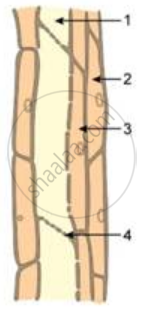
Name the parts labelled 1, 2, 3 and 4.
Study the diagram given below and then answer the question that follows:
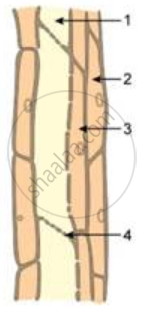
Where is this tissue likely to be found in the plant?
Study the diagram given below and then answer the question that follows:
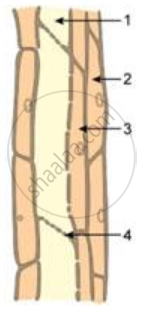
State the function of the parts labelled 1, 2, 3 and 4.
Give the structure and function of the following:
Collenchyma
Write 'True or False' for the following statement:
Sclerenchyma cells have intercellular spaces.
Differentiate between Xylem and Phloem functioning
Name any two simple and two complex permanent tissues in plants.
Fibers are extensively longer ranging from 20 mm to 550 mm ______.
