Advertisements
Advertisements
प्रश्न
Explain how frequency of incident light varies with stopping potential.
Advertisements
उत्तर
1. The effect of frequency of incident light on stopping potential can be studied by keeping the intensity of the incident light constant.
2. The electrode potential varies for different frequencies of the incident light.
3. As the frequency is increased the photoelectrons are emitted with greater kinetic energies so that the retarding potential needed to stop the photoelectrons is also greater.
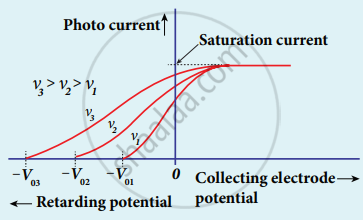
Variation of photocurrent with collector electrode potential for different frequencies of the incident radiation
4. From the graph between frequency and stopping potential, the stopping potential varies linearly with the frequency of the incident light.
5. The stopping potential is zero when no electrons are emitted below a certain frequency called threshold frequency.

Variation of stopping potential with frequency of the incident radiation for two metals
APPEARS IN
संबंधित प्रश्न
A photoelectric surface is illuminated successively by monochromatic light of wavelength λ and `λ/2`. If the maximum kinetic energy of the emitted photoelectrons in the second case is 3 times that in the first case, the work function of the material is
In photoelectric emission, a radiation whose frequency is 4 times threshold frequency of a certain metal is incident on the metal. Then the maximum possible velocity of the emitted electron will be
If the mean wavelength of light from sun is taken as 550 nm and its mean power as 3.8 × 1026 W, then the average number of photons received by the human eye per second from sunlight is of the order of
Photons of wavelength λ are incident on a metal. The most energetic electrons ejected from the metal are bent into a circular arc of radius R by a perpendicular magnetic field having magnitude B. The work function of the metal is
The work functions for metals A, B and C are 1.92 eV, 2.0 eV and 5.0 eV respectively. The metal/metals which will emit photoelectrons for a radiation of wavelength 4100Å is/are
Define stopping potential.
Explain the quantum concept of light.
Give the construction and working of photo emissive cell.
Give the applications photocell.
Calculate the maximum kinetic energy and maximum velocity of the photoelectrons emitted when the stopping potential is 81 V for the photoelectric emission experiment.
