Advertisements
Advertisements
प्रश्न
Explain how frequency of incident light varies with stopping potential.
Advertisements
उत्तर
1. The effect of frequency of incident light on stopping potential can be studied by keeping the intensity of the incident light constant.
2. The electrode potential varies for different frequencies of the incident light.
3. As the frequency is increased the photoelectrons are emitted with greater kinetic energies so that the retarding potential needed to stop the photoelectrons is also greater.
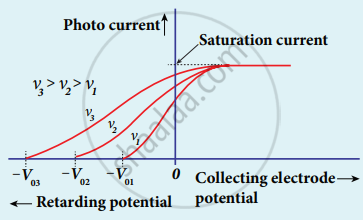
Variation of photocurrent with collector electrode potential for different frequencies of the incident radiation
4. From the graph between frequency and stopping potential, the stopping potential varies linearly with the frequency of the incident light.
5. The stopping potential is zero when no electrons are emitted below a certain frequency called threshold frequency.

Variation of stopping potential with frequency of the incident radiation for two metals
APPEARS IN
संबंधित प्रश्न
When a metallic surface is illuminated with radiation of wavelength λ, the stopping potential is V. If the same surface is illuminated with radiation of wavelength 2λ, the stopping potential is `"V"/4`. The threshold wavelength for the metallic surface is
The work functions for metals A, B and C are 1.92 eV, 2.0 eV and 5.0 eV respectively. The metal/metals which will emit photoelectrons for a radiation of wavelength 4100Å is/are
What is the photoelectric effect?
How does photocurrent vary with the intensity of the incident light?
Mention the different types of photocells.
Briefly discuss the observations of Hertz, Hallwachs and Lenard.
Explain the effect of potential difference on photoelectric current.
Give the construction and working of photo emissive cell.
List out the characteristics of photons.
When a light of frequency 9 × 10¹⁴ Hz is incident on a metal surface, photoelectrons are emitted with a maximum speed of 8 × 10⁵ ms−1. Determine the threshold frequency of the surface.
