Advertisements
Advertisements
प्रश्न
Explain Bredig’s arc method.
Advertisements
उत्तर
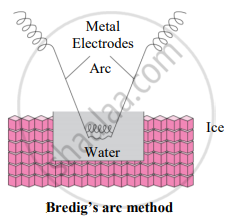
- Colloidal sols can be prepared by electrical disintegration using Bredig’s arc method.
- This process involves vaporization as well as condensation.
- Colloidal sols of metals such as gold, silver, platinum can be prepared by this method.
- In this method, an electric arc is struck between electrodes of metal immersed in the dispersion medium.
- The intense heat produced vapourizes the metal which then condenses to form particles of colloidal sol.
APPEARS IN
संबंधित प्रश्न
Define the following with a suitable example, of each:
Multimolecular colloid
Define the following with a suitable example, of each:
Gel
Choose the correct option.
The size of colloidal particles lies between ______.
Draw labelled diagram Dialysis.
Draw labelled diagram of Bredig’s arc method.
In coagulation of positively charged ferric hydroxide sol, the most and least effective ions are ____________ and ____________ respectively.
Which of the following is multimqlecular colloid?
Some colloids are stable by their nature, i.e., gels, alloys, and solid foams. Gelatin and jellies are two common examples of a gel. The solid and liquid phases in a gel are interdispersed with both phases being continuous. In most systems, the major factor influencing the stability is the charge on the colloidal particles. If a particular ion is preferentially adsorbed on the surface of the particles, the particles in suspension will repel each other, thereby preventing the formation of aggregates that are larger than colloidal dimensions. The ion can be either positive or negative depending on the particular colloidal system, i.e., air bubbles accumulate negative ions, sulphur particles have a net negative charge in a sulphur sol, and the particles in a metal hydroxide sol are positively charged. Accumulation of charge on a surface is not an unusual phenomenon-dust is attracted to furniture surfaces by electrostatic forces. When salts are added to lyophobic colloidal systems the colloidal particles begin to form larger aggregates and a sediment forms as they settle. This phenomenon is called flocculation, and the suspension can be referred to as flocculated, or colloidally unstable. If the salt is removed, the suspension can usually be restored to its original state; this process is called deflocculation or peptization. The original and restored colloidal systems are called deflocculated, peptized, or stable sols.
Why does a small amount of salt have such a dramatic effect on the stability of a lyophobic colloidal system? The answer lies in an understanding of the attractive and repulsive forces that exist between colloidal particles. Van der Waals forces are responsible for the attractions, while the repulsive forces are due to the surface charge on the particles. In a stable colloid, the repulsive forces are of greater magnitude than the attractive forces. The magnitude of the electrical repulsion is diminished by addition of ionized salt, which allows the dispersed particles to aggregate and flocculate. River deltas provide an example of this behaviour. A delta is formed at the mouth of a river because the colloidal clay particles are flocculated when the freshwater mixes with the salt water of the ocean.
Gelatin is a _________ colloidal system.
Some colloids are stable by their nature, i.e., gels, alloys, and solid foams. Gelatin and jellies are two common examples of a gel. The solid and liquid phases in a gel are interdispersed with both phases being continuous. In most systems, the major factor influencing the stability is the charge on the colloidal particles. If a particular ion is preferentially adsorbed on the surface of the particles, the particles in suspension will repel each other, thereby preventing the formation of aggregates that are larger than colloidal dimensions. The ion can be either positive or negative depending on the particular colloidal system, i.e., air bubbles accumulate negative ions, sulphur particles have a net negative charge in a sulphur sol, and the particles in a metal hydroxide sol are positively charged. Accumulation of charge on a surface is not an unusual phenomenon-dust is attracted to furniture surfaces by electrostatic forces. When salts are added to lyophobic colloidal systems the colloidal particles begin to form larger aggregates and a sediment forms as they settle. This phenomenon is called flocculation, and the suspension can be referred to as flocculated, or colloidally unstable. If the salt is removed, the suspension can usually be restored to its original state; this process is called deflocculation or peptization. The original and restored colloidal systems are called deflocculated, peptized, or stable sols.
Why does a small amount of salt have such a dramatic effect on the stability of a lyophobic colloidal system? The answer lies in an understanding of the attractive and repulsive forces that exist between colloidal particles. Van der Waals forces are responsible for the attractions, while the repulsive forces are due to the surface charge on the particles. In a stable colloid, the repulsive forces are of greater magnitude than the attractive forces. The magnitude of the electrical repulsion is diminished by addition of ionized salt, which allows the dispersed particles to aggregate and flocculate. River deltas provide an example of this behaviour. A delta is formed at the mouth of a river because the colloidal clay particles are flocculated when the freshwater mixes with the salt water of the ocean.
Settling down of colloidal particles to form a suspension is called ______.
A colloidal system having a solid substance as a dispersed phase and a liquid as a dispersion medium is classified as ______.
An emulsion cannot be broken by:
(i) heating
(ii) adding more amount of dispersion medium
(iii) freezing
(iv) adding emulsifying agent
Gelatin which is a peptide is added in icecreams. What can be its role?
How do emulsifying agents stabilise the emulsion?
On the basis of Hardy-Schulze rule explain why the coagulating power of phosphate is higher than chloride.
Why is \[\ce{Fe(OH)3}\] colloid positively charged, when prepared by adding \[\ce{FeCl3}\] to hot water?
Match the items of Column I and Column II.
| Column I | Column II |
| (i) Butter | (a) dispersion of liquid in liquid |
| (ii) Pumice stone | (b) dispersion of solid in liquid |
| (iii) Milk | (c) dispersion of gas in solid |
| (iv) Paints | (d) dispersion of liquid in solid |
Cloud is an example of
Which of the following substances will precipitate the negatively charge emulsion
The size of a raw mango shrinks to a much smaller size when kept in a concentrated salt solution. Which one of the following processes can explain this?
In which of the following, the Tyndall effect is not observed?
Smoke is an example of ______.
Which of the following electrolytes will be most effective in coagulating negative sol?
Van Arkel's method of purification of metals involves converting the metal to a ______.
Identify the colloidal molecule containing hydrophilic head and hydrophobic tail within it.
Starch is an example of which of the following type of colloid?
Identify positively charged sol from following.
