Advertisements
Advertisements
प्रश्न
Explain any two reasons for the formation of the NITI Aayog in place of the Planning Commission by the Union Government.
Advertisements
उत्तर
- Following independence, a Planning Commission based on the communist paradigm was constituted for India's planned development. However, in the age of globalisation, particularly in the twenty-first century, it was becoming ineffectual and irrelevant, particularly in terms of dealing with the pressing development concerns.
- As a result, on January 1, 2015, the NITI Aayog was established in place of the Planning Commission with the goal of providing the Union Government with required and technical advise on policymaking at the Central and State levels.
APPEARS IN
संबंधित प्रश्न
Which of the following ideas did not form part of the early phase of India’s development policy ?
What were the major differences in the approach towards development at the time of Independence? Has the debate been resolved?
The Socialist model of development was related to ______.
The Chairman of the National Development Council is ______.
Who among the following was the first chairman of Tripura State Planning Board?
Local Self Government intends to improve ______.
Tripura State Planning Board was set up in ______.
Who appoints the Vice-Chairperson of NITI Aayog?
Who amongst the following is the longest serving member of Tripura State Planning Board?
The entire process of participatory development can be completed in ______.
Which state was carved out of Assam from the following?
The leader and the country that helped to reach the Tashkent agreement between India and Pakistan.
During the Nehru era, why did some political parties and groups in our country believe that India should be more friendly with the bloc led by the US?
Study the picture given below and answer the question that follows:

Choose the first state to be created due to linguistic demands after independence:
Observe the figure below and answer accordingly.
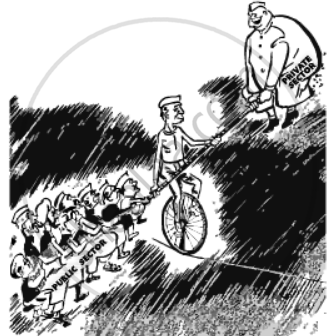
Who in the picture is balancing between the public and private sectors?
Observe the figure below and answer accordingly.
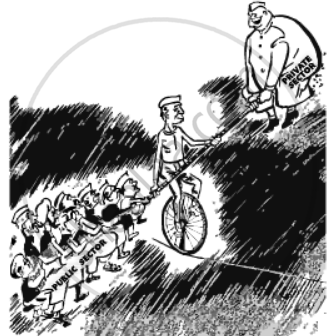
Why has a big tilt towards the public sector been shown in the cartoon?
Read the following paragraph and answer according.
NITI Aayog or National Institution for Transforming India Aayog is basically a policy think tank of Government of India and State Governments that replaces the 65-year old Planning Commission.
The Union Government of India had announced formation of NITI Aayog on 1st January, 2015. The body is composed of a CEO and a Vice Chairperson, to be appointed by the Prime Minister, in addition to some full-time members and two part-time members, while four Union Ministers would serve as ex-officio members.
Besides, there would be specific regional councils, while experts and specialists from various fields would be called as special invitees nominated by the Prime Ministers.
NITI Aayog will serve as a “think tank” of the government as a “directional and policy dynamo” and would provide both to the governments at the centre and in the states with strategic and technical advice on key policy matters including economic issues of national and international importance.
NITI Aayog will have regional councils to focus on developmental activities on specific areas and is patterned on the National Reforms Development Commission of China.
When was NITI Aayog formed?
Read the following passage and answer the question.
"In the early years of Independence, two contradictory tendencies were already well advanced inside the Congress Party. On the one hand, the national party executive endorsed socialist principles of state ownership, regulation, and control over key sectors of the economy in order to improve productivity and at the same time curb economic concentration. On the other hand, the national Congress ·government pursued liberal economic policies and incentives to private investment that was justified in terms of the sold criterion of achieving a maximum increase in production". - Francine Frankel
What is the contradiction that the author is talking about? What would be the political implications of a contradiction like this?
Which of the following option is correct?
Which of the following option is true in the context of the "Kerala Model"?
Which two model of development India had adopted on the eve of independence?
Who was the first vice chairperson of NITI Aayog?
Which factor was responsible for discouraging research and development in the manufacturing sector?
