Advertisements
Advertisements
प्रश्न
During photosynthesis, ________ is produced and stored in the leaf.
Advertisements
उत्तर
During photosynthesis, food is produced and stored in the leaf.
APPEARS IN
संबंधित प्रश्न
Describe an experiment to prove that sunlight is necessary for photosynthesis.
How does carbon dioxide return to the atmosphere? Explain.
A student in order to study the importance of certain factors of photosynthesis took a potted plant and kept it in the dark for over 24 hours. Then in the early hours of the morning the student covered one of the leaves with black paper in the centre only. Student placed the potted plant in the sunlight for a few hours, and then tested the leaf which was covered with black paper for starch.
(i) What aspect of photosynthesis was being investigated?
(ii) Is there any control in this experiment? If so, state the name.
(iii) Why was the plant kept in the dark before the experiment?
(iv) Describe step by step how the candidate proceeded to test the leaf for the presence of starch.
The production of starch, and not glucose, is often used as a measure of photosynthesis in leaves because
Name the following:
The category of organisms that prepare their own food from basic raw materials.
Name the following:
The first form of food substance produced during photosynthesis.
Oxygen given out during photosynthesis comes from water. Explain this statement.
Explain the Term ATP.
When iodine solution is added for testing starch, part of the leaf with ______ turns a blue-black color.
An organism A which cannot move from one place to another makes a simple food B from the substances C and D available in the environment. This food is made in the presence of green-colored substance E present in organs F in the presence of light energy in a process called G. Some of the simple food B also gets converted into a complex food H for storage purposes. Does this food give a blue-black color with iodine solution?
a. What is
- organism A
- food B?
- food H?
b. What are C and D?
c. Name green-colored substance E and organ F.
d. What is the process G?
Study the diagram given below and fill in the blanks with suitable words:
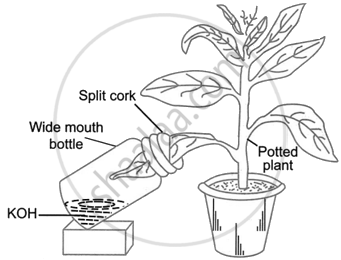
In order to prove that carbon dioxide is necessary for
(a) ______, a potted plant is placed in dark for 48 hours to (b) ______ the leaves. A part of a leaf is inserted into a conical flask containing potassium hydroxide solution. This is to absorb (c) ______ from the flask. The plant is then placed in sunlight for a few hours. The experimental leaf is tested for starch. The part of the leaf that was inside the conical flask turns (d) ______, whereas the part of the left outside turns (e) ______ in colour.
