Advertisements
Advertisements
प्रश्न
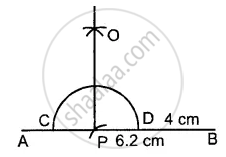
Draw a line segment AB = 6.2 cm. Mark a point P in AB such that BP = 4 cm. Through point P draw perpendicular to AB.
Advertisements
उत्तर
Steps of Construction :
- Draw a line segment AB = 6.2 cm
- Cut off BP = 4 cm
- With P as the centre and some radius draw arc meeting AB at the points C, D.
- With C, D as centres and equal radii [each is more than half of CD] draw two arcs, meeting each other at the point O.
- Join OP. Then OP is perpendicular for AB.
APPEARS IN
संबंधित प्रश्न
Draw a line segment of given length and construct a perpendicular bisector to line segment using scale and compass
5.6 cm
Draw a line segment of given length and construct a perpendicular bisector to line segment using scale and compass
10.4 cm
Draw a line segment of given length and construct a perpendicular bisector to line segment using scale and compass
58 mm
Infinitely many perpendiculars can be drawn to a given ray.
Infinitely many perpendicular bisectors can be drawn to a given ray.
Copy figure on your notebook and draw a perpendicular to l through P, using (i) set squares (ii) protractor (iii) ruler and compass. How many such perpendiculars are you able to draw?

Bisect ∠XYZ of figure.

Draw a line segment of length 10 cm. Divide it into four equal parts. Measure each of these parts.
Which two conditions, when combined, define the Perpendicular Bisector of a line segment AB?
What is the minimum compass opening required when constructing a perpendicular bisector of line segment AB?
