Advertisements
Advertisements
प्रश्न
Do you remember magic triangles? Come now, let s make some magic squares.
- Fill this square using all the numbers from 21 to 29.
Rule: The total of each side is 75.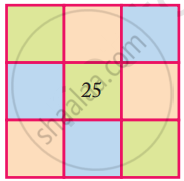
Advertisements
उत्तर
Given that total of each side is 75
We can use numbers from 21 to 29.
- In the first row:
The required number
= 75 – (26 + 22)
=75 – 48 = 27 - In the first column:
The required number
= 75 – (26 + 28)
= 75 – 54 = 21 - In the second row:
The required number
= 75 – (21 + 25)
= 75 = 75 – 46 = 29 - In the third row:
The required number
= 75 – (28 + 24)
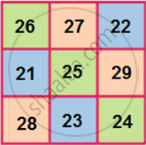
= 75 – 52 = 23 - Number in first box = 28
Number in second box = 23
So, number in third box
= 75 – (28 + 23)
= 75 – 51= 24
Hence, the complete magic square is as follows:
संबंधित प्रश्न
Without performing actual addition and division write the quotient when the sum of 69 and 96 is divided by
(i) 11
(ii) 15
Which of the following statement is true?
If a number is divisible by 8, it must be divisible by 4.
Do you remember magic triangles? Come now, let s make some magic squares.
- Fill this square using all the numbers from 46 to 54.
Rule: The total of each line is 150.
Fill in the blank space in the same way.

If 6A × B = A 8 B, then the value of A – B is ______.
If  then B = ______.
A three-digit number abc is divisible by 6 if c is an even number and a + b + c is a multiple of 3.
Number 7N + 1 will leave remainder 1 when divided by 7.
If 148101B095 is divisible by 33, find the value of B.
If 56 × 32y is divisible by 18, find the least value of y.
