Advertisements
Advertisements
प्रश्न
Do the following activity in groups.
Go to the library and collect information about the lifestyle of people in desert areas— their food, clothes, work, social customs, etc. Share this information with the group.
Advertisements
उत्तर
The nomads are homeless people in desert areas. They keep shifting to places where they can get food and fodder. Their life is very hard. They use camels for transportation. They eat mainly meat and dates. They weave their clothes from the wool of camel or sheep. Their lifestyle is very simple. They look to the sky for rain water. They have developed their own customs.
संबंधित प्रश्न
Discuss in pair and answer question below in a short paragraph (30 − 40 words.
Why did Jerome have to reopen the packed bag?
Thinking about the Text
On the following map mark out the route, which the author thought of but did not take, to Delhi.
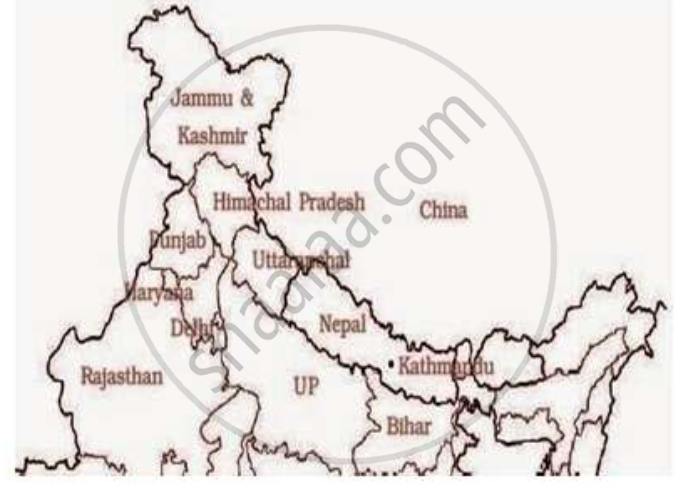
Answer the question in a short paragraph.
The author has drawn powerful images and pictures. Pick out three examples each of
(i) the atmosphere of ‘febrile confusion’ outside the temple of Pashupatinath (for
example: some people trying to get the priest’s attention are elbowed aside…)
(ii) the things he sees
(iii) the sounds he hears
Name all the people who are tried in the king’s court, and give the reasons for their trial.
Think of an occasion when you participated in a team competition. Think back on the leadership qualities displayed by your Team Leader/Captain. Recollect the specific incidents when those were displayed and how they contributed to the success of the team.
Write an e-mail to your mentor-teacher sharing this experience.
The poem is about a brook. A dictionary would define a brook, as a stream or a
small river. Read the poem silently first. After the first reading, the teacher will
make you listen to a recording of the poem. What do you think the poem is all
about?
I come from haunts of coot and hern;
I make a sudden sally
And sparkle out among the fern,
To bicker down a valley.
By thirty hills I hurry down,
Or slip between the ridges,
By twenty thorpes, a little town,
And half a hundred bridges.
Till last by Philip's farm I flow
10 To join the brimming river,
For men may come and men may go,
But I go on for ever.
I chatter over stony ways,
In little sharps and trebles,
15 I bubble into eddying bays,
I babble on the pebbles.
With many a curve my banks I fret
By many a field and fallow,
And many a fairy foreland set
20 With willow-weed and mallow.
I chatter, chatter, as I flow
To join the brimming river,
For men may come and men may go,
But I go on for ever.
25 I wind about, and in and out,
With here a blossom sailing,
And here and there a lusty trout,
And here and there a grayling,
And here and there a foamy flake
30 Upon me, as I travel
With many a silvery waterbreak
Above the golden gravel,
And draw them all along, and flow
To join the brimming river
35 For men may come and men may go,
But I go on for ever.
I steal by lawns and grassy plots,
I slide by hazel covers
I move the sweet forget-me-nots
40 That grow for happy lovers.
I slip, I slide, I gloom, I glance,
Among my skimming swallows;
I make the netted sunbeam dance
Against my sandy shallows.
45 I murmur under moon and stars
In brambly wildernesses;
I linger by my shingly bars;
I loiter round my cresses;
And out again I curve and flow
50 To join the brimming river,
For men may come and men may go,
But I go on for ever.
About the Poet
Lord Tennyson (1809-92) was born in Lincolnshire. Poet Laureate for over 40 years, Tennyson is representative of the Victorian age. His skilled craftsmanship and noble ideals retained a large audience for poetry in an age when the novel was engrossing more and more readers. Tennyson's real contribution lies in his shorter poems like The Lady of Shallot, The Princess, Ulysses, The Palace of Art etc. His fame rests on his perfect control of sound, the synthesis of sound and meaning, and the union of visual and musical.
What does he plant who plants a tree?
He plants, in sap and leaf and wood,
In love of home and loyalty
And far-cast thought of civic good____
His blessing on the neighbourhood,
Who in the hollow of his hand
Holds all the growth of all our land____
A nation's growth from sea to sea
Stirs in his heart who plants a tree.
Read the lines given above and answer the question that follow:
Some are Purple and gold flecked grey
For she who has journeyed through life midway,
Whose hands have cherished , whose love has blest,
And cradled fair sons on her faithful breast,
And serves her household in fruitful pride,
And worship the gods at her husband's side.
Read the lines given above and answer the question that follow:
Explain:
And cradled fair sons on her faithful breast,
And serves her household in fruitful pride,
And worships the gods at her husband’s side.
What roused the pride of the animals and made them reconcile to the new arrangement? In the meanwhile, what sudden decision was taken by the pigs? What do we learn about Napoleon at this juncture?
How fire is a good servant?
Mention the year when the cricket rules were written for the first time
What were the primary objectives of the NASA Viking Mission to Mars?
Bring out some of the sterling qualities of the character of Taro.
Or
Give a character sketch of Taro.
Describe the appearance of Miss Beam.
How does the child finally decide to observe his teacher’s activities at home?
What decisions were given by Algu and Jumman as head Panch?
What did the speaker’s brother say about the Shed?
Why did the author order so many pairs of boots? Did he really need them?
Read the following extract from Maya Angelou’s poem, ‘When Great Trees Fall’ and answer the questions that follow:
| When great trees fall in forests, small things recoil into silence, their senses eroded beyond fear. |
- What effect does the falling of a ‘great tree’ have on the creatures of the forest? [3]
- How does the death of a great soul affect the lives of those left behind in the immediate aftermath of their passing? [3]
- What long-term effect does the death of a ‘great soul' have? [3]
- What feeling is being expressed by the following lines/phrases? [3]
- small things recoil into silence
- kind words/unsaid,
- Beand be/better. For they existed
- What is a ‘Great tree’ a metaphor for? [4]
What is the central message of Angelou’s poem, “When Great Trees Fall"?
Which of the following BEST captures the central idea of the short story, The Medicine Bag?
