Advertisements
Advertisements
प्रश्न
Describe the bones of vertebral column.
Advertisements
उत्तर
The vertebral column is made up of 33 r ing shaped bones called vertebrae. A typical vertebra has a main body or centrum and a neural canal in the centre of the neural arch, arising from the sides of the centrum. Neural spine is a flat, longitudinal projection. There are side projections called transverse processes. The articular facets help in j oining the two adj a cent vertebrae.
Vertebral column is divided into the following five parts:
(i) Cervical region - It has seven cervical vertebrae. First vertebra is called atlas, second is axis while the resta re called typical cervical vertebrae.
(ii) Thoracic region - It has 12 thoracic vertebrae. Neural spine of these vertebrae is long and pointed, which provides surface for muscle attachment.
(iii) Lumbar region - Has 5 lumbar vertebrae.
(iv) Sacral region - Has 5 sacral vertebrae which are permanently fused to each other.
(v) Caudal region - Has 4 caudal vertebrae, which are fused to form a triangular structure called coccyx .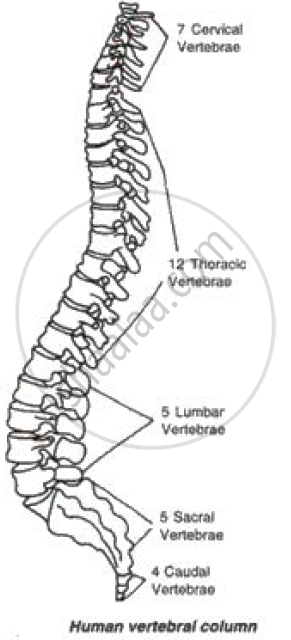
APPEARS IN
संबंधित प्रश्न
How many vertebrae are found in human neck? Give their names.
What are the various parts of a typical vertebra?
Name the bones that make up upper arm and lower limb of man.
The question has four options. Choose the correct answer:
Smallest bone of man is
The place where two or more bones are connected is called a ______.
Answer the following question in your words.
What should you do to keep your bones strong and healthy?
Answer the following question in your words.
Which are the various reasons due to which our bones might break?
Answer the following question in your words.
What are the different types of bones? How many types are there?
The forearm has two bones.
Bones are hard structures and cannot be bent. But, we can still bend our elbow, knee, etc. How is this possible?
