Advertisements
Advertisements
प्रश्न
Describe, with the help of a suitable diagram, the working principle of a step-up transformer. Obtain the relation between input and output voltages in terms of the number of turns of primary and secondary windings and the currents in the input and output circuits.
Advertisements
उत्तर
Principle − It works on the principle of electromagnetic induction. When current in one circuit changes, an induced current is set up in the neighbouring circuit.
Construction

Working
-
Alternating emf is supplied to the primary coil PP’. The resulting current produces an induced current in secondary.
-
Magnetic flux linked with primary is also linked with the secondary. The induced emf in each turn of the secondary is equal to that induced in each turn of the primary.
Let
EP − Alternating emf applied to primary
nP − Number of turns in the primary
`(dø)/dt - `Rate of change of flux through each turn of primary coil
∴`E_p = - n_p (dø)/dt .......... (1)`
Es− Alternating emf of secondary
ns − Number of turns in secondary
∴`E_s = - n_s (dø)/dt .......... (2)`
Dividing equation (2) by (1),
`E_s/E_p = n_s/n_p = k`
For step-up transformer, K > 1
∴ Es > Ep
-
According to law of conservation of energy,
-
Input electrical power = Output electrical power
EpIp = EsIs
∴ `E_s/E_p = I_p/I_s`
APPEARS IN
संबंधित प्रश्न
Explain the construction and working of the transformer.
Draw a labeled diagram of a step-down transformer.
The following diagram in Fig.10.42 shows a coil of several turns of copper wire connected to a sensitive centre zero galvanometer G near a magnet NS. The coil is free to move in the direction shown in the diagram.
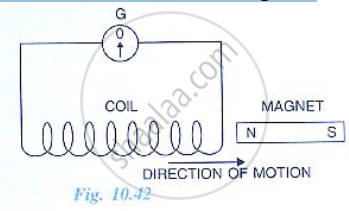
(i) Describe the observation if the coil is rapidly moved.
(ii) How would the observation be altered if (a) the coil has twice as many turns (b the coil was made to move three times as fast?
How are the e.m.f in the primary and secondary coils of a transformer related with the number of turns in these coils?
The secondary windings of a transformer in which the voltage is stepped down are usually made of thicker wire than the primary. Explain why.
Draw the effective equivalent circuit of the circuit shown in figure, at very high frequencies and find the effective impedance.

Two coils P and Q are kept near each other. When no current flows through coil P and current increase in coil Q at the rate 10A/s, the emf in coil P is 15mV. When coil Q carries no current and current of 1. 8A flows through coil P, the magnetic flux linked with the coil Q is ______.
What is a transformer?
What drives current through the connected load and delivers AC output?
