Advertisements
Advertisements
प्रश्न
Describe Bohr’s model of the atom.
Advertisements
उत्तर
A Danish physicist, Neils Bohr, offered the following postulates for modifying the Rutherford model.
- Atoms have a core nucleus surrounded by electrons.
- An atom comprises a small, positively charged nucleus at the centre, around which electrons travel in circular paths known as orbits or shells.
- Each orbit has a defined amount of energy; hence, they are known as energy levels or energy shells.
- The energy shells' order will be
K < L < M < N < O < .........
or, 1 < 2 < 3 < 4 < 5 < ......... - An electron does not lose or gain energy while remaining in a specific orbit.
- When an electron moves in an orbit, it absorbs and emits no energy. However, energy is absorbed when it moves from a lower to a higher orbit, and energy is emitted when it moves from a higher to a lower orbit.
संबंधित प्रश्न
Describe Bohr's model of the atom. How did Neils Bohr explain the stability of atom?
In the figure given alongside
(a) Name the shells denoted by A,B, and C. Which shell has least energy
(b) Name X and state the charge on it
(c) The above sketch is of …………. Model of an atom

State in brief the drawbacks of Rutherford's atomic model correlating them with the postulates of Bohr’s atomic model.
State true or false. If false, correct the statement.
Smaller the size of the orbit, lower is the energy of the orbit.
An atom with 3 protons and 4 neutrons will have a valency of
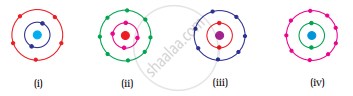
Which of the following in Fig. 4.2 do not represent Bohr’s model of an atom correctly?
Niels Bohr was Born on ______.
The scientist who proposed the atomic model based on the quantisation of energy for the first time is ______.
A particle of mass ‘m’ and charge ‘−2q’ is moving around a very heavy particle having charge ‘q’. If Bohr’s model is to be used then the orbital velocity of mass ‘m’ when it is nearest to the heavy particle is (in magnitude) (ε0 = permittivity of free space, h = Planck’s constant) ______.
The angular momentum of electron in hydrogen atom in first orbit is ‘L’. The change in angular momentum if electron is in second orbit of hydrogen atom is ______.
