Advertisements
Advertisements
प्रश्न
Describe any four aims of the peace programme of Woodrow Wilson.
Advertisements
उत्तर
President Woodrow Wilson of America was a very peace loving man. In January, 1918, he put forward a peace programme consisting of fourteen points to end the First World War. These points included:
(i) Discard of secret treaties,
(ii) Freedom ip the use of seas by all nations,
(iii) Reduction in armaments,
(iv) Conduct of negotiations between different states openly,
(v) Evacuation of Belgium by Germany,
(vi) Restoration of Alsace-Lorraine to France,
(vii) Creation of independent States in Europe, and
(viii) Establishment of a world organisation to guarantee political independence and territorial integrity of different States.
Many of the above points were covered by the different treaties that were signed after the First World War. For instance, Belgium \yas evacuated by Germany: Alsace and Lorraine were returned to France; many small states like Poland, Finland, Czechoslovakia, Latvia, etc. were created on the.principle of nationality, and an international organisation with the name of the League of Nations was created to maintain the world peace.
संबंधित प्रश्न
The 1914 and 1939 Wars that engulfed almost the entire world were known as World Wars due to its unprecedented impact and dimension. In this context, answer the following:
Mention any four terms of the treaty of Versailles which affected Germany after World War I.
What was the number of war criminals of Germany who were identified?
When and between whom was the Treaty of Versailles singed?
What were the consequences of the First World War?
Mention two most important clauses of the Treaty of Versailles.
What changes has occured in the Political map of the world after the First World War.
What did France gain from the Treaty of Versailles.
Explain the effects of First World War on Austria-Hungar.
Explain how First World War brought about a changed political scenario of the world.
Answer the following: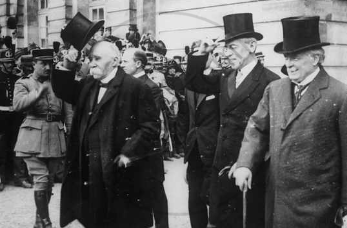
(i) Name the three gentlemen in the picture.
(ii) With which settlement they were associated.
